Thursday, November 26, 2020

SALEM'S LOT (1979)

Directed by Tobe Hooper.  Written by Paul Monash
Starring David Soul, James Mason, Lance Kerwin, Bonnie Bedelia, Reggie Nalder, Geoffrey Lewis, Lew Ayres
1979, 183 minutes, Color, Unrated, 1.33:1
Warner Archives, released 2016


Summary:
Novelist Ben Mears returns to his hometown of Salem's Lot, ostensibly to write his next book but also to work through a traumatic experience from his youth where he thinks he saw the ghost of the owner of the Marsten House.  Now an adult, he wants to explore the nature of evil and whether material things--such as a house--can be inherently evil.  He tried to rent the house but discovers that it's already been rented by two new businessmen, Mr. Barlow and Mr. Straker.  People start to die and Ben comes to think that Barlow and Straker are at fault.  In fact, he comes to think that the supernatural might be involved as some of the victims show evidence of bite marks and missing blood.


Salem's Lot by Stephen King was originally published in 1975 as his second novel.  King had considerable success with his first novel, Carrie, and Lot also sold like gangbusters in paperback.  From a literary standpoint, Lot represented a large jump in quality from Carrie, in that it is a real densely plotted story instead of the pastiche of styles that Carrie used*.  Taking clear influence from Bram Stoker's Dracula, King infuses that gothic base with melodrama worthy of any soap opera.  This is not meant as a criticism.  It's been a few years since I've read the book, but I've always thought it was absolutely fabulous, so at least for me King's approach worked.


SALEM'S LOT was originally broadcast over two nights in 1979.  I missed Part 1 but was scared silly by Part 2.   After those initial TV runs, it was only available on video in the 112-minute theatrical version released outside the U.S.  Besides being 70+ minutes shorter, this theatrical version also had at least two censorship differences from the original broadcast version, which will be discussed below.  I recall trying to watch the shorter version on VHS but not liking it—I kept missing parts in the longer version.  

The cast of SALEM'S LOT is above average for a television production, and by this I mean that James Mason is great.  Outstanding even.  He brings a fair amount of class to the proceedings and digs into his first true horror role with true aplomb.  The rest of the cast is a mixture of familiar TV faces with some out of the ordinary faces, at least for a television horror production.  David Soul, Bonnie Bedelia, and Lance Kerwin were all well-known TV staples at the time of filming, while Mason, Nalder, Ayres, and Lewis were perhaps better known at this time for their movie work.   Soul is not bad in the lead, and does not seem out of his league portraying an intellectual.  Bedelia is somewhat better, though she ultimately has little to do.  Kerwin is even better yet, playing an awkward teenager believable.  Reggie Nalder, as Barlow, is an imposing sight but does not really have much to do.  Lewis especially shines, being one of the few actors to attempt a New England accent and brings a real strength to his scenes as a vampire.


The film's structure largely follows the book's, except for a wraparound section that frames the entire story as a flashback.  In this prologue and epilogue, Soul and Kerwin travel the world and encounter a vampire they must kill.  It is not clear exactly what they are doing — whether they are in hiding or hot on the trail of more vampires.  One could argue that they were looking for Bedelia's character, but again, it not's made clear.  Reportedly, the wraparounds were done to facilitate a weekly series, or at least a sequel.  It is easily the film's weakest part.

The film generally handles the narrative smoothly, with subtle character shading and a clear, linear flow.  The buildup to Mr. Barlow's arrival from Europe is well handled, and although the last third feels a bit rushed, it is still very effective.  The film occasionally betrays its television origins with some variable set designs, such as Kerwin's bedroom.  Yet at other times the production design is outstanding, such as the interior of the Marsten house.  In his first television assignment, director Hooper generates real suspense in several scenes and includes some great, story-motivated jumps.


As mentioned previously, when the film was shortened for its theatrical release several alternate shots were used.  The differences are:
  • When Cully Sawyer (George Dzundza) finds Larry Crockett (Fred Willard) with his wife, he holds a shotgun on him.  In the theatrical version, he makes Larry put the barrels of the gun in his mouth.  In the TV version, Larry holds the gun up to his face.
  • When Bill Norton (Ed Flanders) is killed, we see him actually be impaled on the antlers.  The aftermath is also shown longer.
  • The staking of Barlow (Reggie Nalder) at the end is somewhat gorier.
  • The entire sequence in the basement at the end was reportedly darkened for television.  I have never seen this confirmed officially anywhere, so take this one with a grain of salt.

According to Producer Richard Kobritz these alternate shots were created for the European theatrical release and not intended for the television version***.  That said, every home video release after the VHS release of the movie version has used some or all of these shots.   At least some subsequent releases included the Larry Crockett scene but not the Flanders scene.  These variations were probably not intentional.   The full version was released on laserdisc and DVD in the 1990's.   The laserdisc version included the censored shots in the European cut, but I am not sure if the DVD did as well.  More recently, Warner Archives released the full version on Blu-Ray.   I put off rewatching the full miniseries for years, hoping to find a high-quality version.  Prior to this Blu-Ray the best version I had seen was an HD version available for streaming on the now-defunct Warner Archive site.  The Blu-Ray bests that HD version by a fair margin, offering a strong colorful image with almost no print damage on view.  
 

Cover of the Blu-Ray:


The excellent Tobe Hooper's Salem's Lot: Studies in the Horror Film edited by Tony Earnshaw collects all previous literature of note on this film, and adds a fair amount of new work.  Long out of print, this is worth picking up if you can find it.


I'm not implying that Carrie is a worse work mind you, but it's easier to put a story together that way than to write it all in one style and point of view.  I may, of course, be full of shit on this.

** Curiously, now that it's all but impossible to see the shorter cut I find I have a compelling urge to watch it again.

***Cinefantastique, Vol. 9, number 2.

Wednesday, August 1, 2018

DAMNATION ALLEY (1977)

Directed by Jack Smight.  Written by Alan Sharp and Lukas Heller.
Starring George Peppard, Jan-Michael Vincent, Paul Winfield, Dominique Sanda, Jackie Earle Haley
1977, 91 minutes, Color, Rated PG, Panavision 2.35:1, in Sound 360°


The Earth is thrown off its access as the result of an all-out Nuclear war.  This disrupts weather patterns and the planet's magnetic field.  As a result, there are monstrous storms that ravage the land and the sky displays wild multicolored light shows constantly.  A small band of survivors holed up in a military missile silo build heavy-duty trucks and plan to travel to Albany, which is the only major U.S. city that was not hit directly by a nuclear bomb.


Background:

DAMNATION ALLEY began as an 'A' science fiction film in the era before STAR WARS. At this point in time science-fiction films generally did not have large budgets, which makes it something of an anomaly that it was so well funded.   It had an initial budget of $7 million dollars and some reports had it ballooning to $17 million because of the special effects.  However, given that the film's special effects are inconsistent and that stock footage is used extensively, it seems likely that the reports of $17 million were exaggerated. 

From all reports, the film began with good intentions.  It was based on Roger Zelazny's novella of the same name, but the final film bears little resemblance to the story. In the original story, the lead character, Tanner, is an ex-Hell's Angel and a real badass.  Released from prison in order to transport much-needed medical supplies across the country, the bulk of the story is taken up with his trek across a nuclear-ravaged landscape affectionately known as "Damnation Alley".  The initial script by Lukas Heller largely followed that story, but the subsequent drafts by Alan Sharp jettisoned it, creating something very different.  Tanner is now an ex-air force man and decidedly less of a badass, even though he is played by Jan-Michael Vincent.  There is still a trip across the country, but unlike the country of the original story there are far fewer people left alive to encounter.


Principal photography for DAMNATION ALLEY took place from June 1976 to September 1976, but it remained in post-production for more than a year.  It was announced as DAMNATION ALLEY, but for most of its post-production period it was called SURVIVAL RUN.  Very shortly before it was released it reverted back to DAMNATION ALLEY.   Trade magazines report that the film has numerous difficulties.  The crux of the issues was that the initial attempts to depict a post-apocalyptic world simply didn't work that well.   The original idea seems to have been to show the effects of nuclear war through bad weather, mutated critters such as giant scorpions and hungry cockroaches, and empty roads.  Perhaps more to the point, the original intent was to focus on the people, but the final result did the opposite.  A full-size vehicle dubbed the "Land Master" was constructed for the film.  It was a fully functional vehicle on the outside and was used extensively in the production.  The Land Master interiors were all filmed on a soundstage—the actual vehicle interior was little more than seats.

The giant scorpion scene was originally filmed using full-size mechanical scorpions that reportedly did not move well.  One of the lobby cards for the film showed the original scorpions (seen below), and while it's hard to judge without seeing them in motion, they indeed don't look all that impressive.     The sequence was ultimately achieved using live scorpions and some poor blue screen process work.  It's hard to imagine that the original version of the sequence could have been worse than what they ended up with. The first two images come from the film, the next four are from the original version of the sequence.


The cockroach attacks were realized using real cockroaches and "mats" of fake cockroaches strung together and pulled across the ground.  They tried to edit around much of this, but like the scorpions, the cockroaches also go down as something that just doesn't look all that convincing on screen.  It's not a bad idea, mind you, it's just that it was executed poorly.

The other issues they attempted to fix are more conceptual.  Aside from the large critters, the film's only other nod to the nuclear devastation is the monster storms that play out twice.  To be fair, these sequences are not that bad.  Both can generate a moderate amount of suspense despite some shaky effects.   

For a country riddled with nuclear craters, however, there is ultimately very little devastation on display.  True, we do see a casino overrun by the desert (courtesy a matte painting reportedly by Matthew Yuricich), but other than that, we don't see anything else besides some empty roads. And if Vegas is merely overrun with sand but otherwise livable (they meet a woman living there) where are all the people?


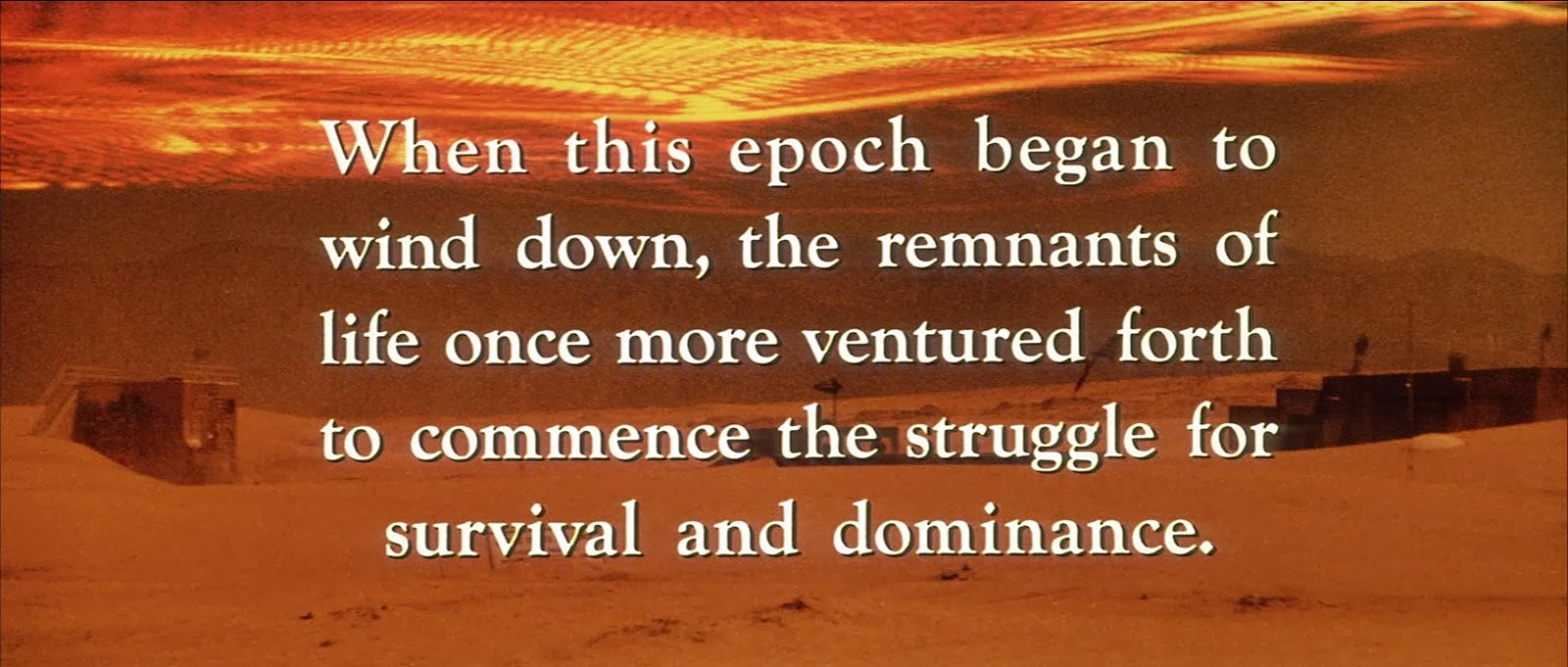
To better sell the post-apocalyptic nature of the story a kaleidoscope of constantly changing colors and shapes was added to every shot that contained the sky.  The sky effects are interesting, but the compositing required to achieve them caused significant image degradation.  Grain is through the roof on just about every shot that shows the sky.


The film was reportedly re-edited several times in post-production to improve its playback.  20th Century Fox liked the Land Master so they asked that more footage of it be used in the film.  They also apparently wanted it shorter for the film lost a number of scenes before it was finally released.  When the movie was shown on TV in the early 80's some of this footage was added back in, and my memory is that it improved things.  As it is, Murray Hamilton appears on screen but has no lines--in the television version there was at least one scene with Hamilton and George Peppard.  For his part, Peppard was not pleased with the cuts made:

"I will say that when we completed the film, I thought we had a very good film.  Jack Smight directed it.  At that point, I think, it cost about $6,500,000.  They went to $8,000,000 with technically changing the colour of the skies and editing.  They totally re-edited the film--the executives at 20th Century Fox!

"And the film as you will see it[...]is no longer the film that Jack created.  Unfortunate, because he did a wonderful job.

"It was the story of some people who go across America from the New Mexico area to Albany, New York, with one of those futurist things called a Landmaster.  It's a trek story, as we call it.  The only humanity is what happens between the people: the relationships, the sexuality, the attempted murders, and so forth.

"None of which you will see now.  That's out!

"It's a trek story about this Landmaster now.  With purple skies."*

Evaluation:

DAMNATION ALLEY begins with a nod towards realism.  George Peppard and Jan-Michael Vincent portray army regulars assigned to a nuclear missile silo.   During one of their shifts, an all-out attack occurs from Russia (one presumes from the maps shown on the screen) and they must launch their missiles.   That this sequence is as effective as it is, using nothing but stock footage, is impressive.  I have no idea if the procedures shown in the film are technically accurate, but they FEEL accurate and anyone who grew up in the era where nuclear war seemed a distinct possibility will likely respond to the events on screen.


The story then picks up two years after the war, and from all appearances, the country is no longer radioactive.  Well, that's not entirely true.  We are told that large portions of the country are now both uninhabitable and impassable, but we don't see any of this.  "Damnation Alley" is a narrow path between devastated areas, leading to their end goal: Albany, New York.   The film is determined not to dwell on anything that veers from the path of showing the trip across the country.  There are stops along the way, but they serve only as conveniences for the narrative.  They stop in Las Vegas to add a woman to the cast.  They stop at a roadside gas station so a boy can be added to the cast.  They stop in Salt Lake City so a character can be eaten by cockroaches (in under 5 minutes!).  We get little indication of what went on in the Army base in the two years between the war and the start of the trip across the country.  True, we know that Peppard's character was busy building the Land Masters, but we see precious little of anything else.  Character development is rudimentary at best--Peppard and Jan-Michael Vincent don't like each other but by the end of the film they still don't like each other but begrudgingly respect one another.


The climax of the film is a storm so large and powerful that it knocks the Earth back on it's proper axis.  Or maybe it's that the Earth moves back to its proper axis, which causes the storm.  It's hard to say because the storm is not explained in the movie.  It is fortuitous that the storm waited until our heroes were just about at Albany before it began, or they may not have made it to the end of the story.  Albany, when it is shown, is a paradise of green fields and well-fed people.  One can only surmise that the extreme weather that was affecting the rest of the world for the previous two years missed their little haven, for their crops seems not to have suffered any.


DAMNATION ALLEY is something of a dumb movie, there is simply no getting around that. The biggest knock against the film--aside from its dumbness--is its poor special effects.  For the record, the special effects ARE bad, mostly due to poor blue-screen work, and there is a lot of it in the film.   Almost every single shot of the sky has been processed to appear appropriately apocalyptic--it's colorful and interesting, but doesn't make much sense.  Because every scene featuring the sky contains an optical composite, much of the film is grainy due to the generation loss inherent to the process.  Throw in some poorly handled practical effects and one very badly done miniature, and well, you have the mess that is DAMNATION ALLEY.

And yet...

I like the movie quite a bit.  Possibly this is due to having seen it originally at an impressionable age, but mostly I think that it's a decent 'B' movie.  That is, it is not a boring movie.  It may not make sense, but it is easy to watch.  It's not the movie's fault that 20th Century Fox promoted it as an 'A' movie, so I try not to hold it against it.  Are the special effects bad? Yes.  Yes, they are.   When taken in the spirit of a 'B' movie, however, does this really matter?  Are any of the classic Godzilla movies any less enjoyable because you can obviously tell it's a guy in a suit?  Is the original BLOB any less enjoyable because its special effects don't really work?    Heck, even KING KONG (1933) has some dodgy effects shots in it.**    For me, it doesn't matter that the special effects are wonky--DAMNATION ALLEY marginally does more right than it does wrong.   I like the simple characters, I like the nonsensical story arc, heck, I even like Jan-Michael Vincent in it.  Why?  Movies about the apocalypse are inherently interesting, regardless of overall quality.  Could ALLEY have done more with the premise?  Undoubtedly, but the movie moves so quickly you don't mind while watching.

Am I proud of liking this movie?  No.  There's no accounting for taste, I guess.

Some other random thoughts:
  • The Land Master is one of the greatest props ever constructed for a film. Although two are shown in the film, only one was constructed.  Shots that show both at the same time were achieved either by optical effects or trickery.  The vehicle was reportedly not easy to drive. 
  • Murray Hamilton has no lines in the released film, although he is featured several times in close-ups.  I believe his voice can be heard during the sequence where the Army base blows up.
  • And did I mention that it has giant "killer" cockroaches? Even with the somewhat botched execution on screen (and the lack of logic inherent in the idea) it's a compelling screen sequence. 
  • The question of residual radiation is never really addressed.  One would think that two years is not long enough for a safe passage close to irradiated zones.  Also, Salt Lake City shows blast damage, which makes me wonder if it was from a nuclear blast.  Yet, our heros walk around without a care in the world.  Perhaps I am thinking too much.
  • The film's title sequence features a great, energetic theme by Jerry Goldsmith that plays over an absolutely riveting depiction of what looks to be a normal run-of-the-mill meeting in the control room.  I can't help but think that the score would have been more effective over something—anything—else.
  • This film is cut down to the bone.  There is just enough here to tell a coherent story, but every time the film threatens to provide some characterization or background, it cuts away and we're on to the next thing.  I guess 20th Century Fox didn't have much faith in the finished film, but they really did the story a disservice by cutting it down so much.  Paul Talbot, in his excellent commentary on the 2018 Signal One Blu-Ray, reports that the original final cut was over two hours long.

Anchor Bay originally announced this for DVD, but later canceled it because they reportedly couldn't find sufficient source material.  Shout! Factory also couldn't find good source material but released it anyway.   A release print was used by the looks of it.  Scratches were somewhat cleaned up but it's hard to judge the film's color due to the processing of the shots with the sky.  The buyer should beware because this is one ugly-looking movie.  Then again, if you're looking to get this on Blu-Ray you probably already know what you are getting into.


The audio is presented in 7.1 lossless but I found it disappointing. The original Sound 360° elements reportedly could not be used either because they had deteriorated or could not be found.  For a film this marginal, it could have used the extra punch of an imaginative sound design.  Alas, only the music shows any true separation--all of the dialogue and effects are rooted more or less in the front center of the mix.  Jerry Goldsmith's music is easily one of the best things about the film, so having it sound so great is a definite plus.

Sound 360 was developed to be a surround format for either 4-track or 6-track soundtracks, and as designed, was intended to be used with discrete sound elements for a hyper directional experience by moving the right and left speakers out in the theater as opposed to with the screen.  Given that Dolby surround was making significant headway to becoming the industry standard movie soundtrack system, this appears to have been an attempt for Fox to come up with their own sound system.   As Fox was trying to spruce up ALLEY to compete with STAR WARS the decision was made to mix the film in this new format.***  Unfortunately, contemporary reports of what it actually sounded like are hard to come by.  Only this film and DAMIEN: OMEN II were ever released with it.

On a side note, DAMNATION ALLEY's Sound 360° implementation was reportedly done at the last minute and was based on the original mono mix.  One wonders how effective it really was.  First hand reports from anyone who actually saw the movie in Sound 360° are hard to find (meaning I could only find one).  From its description, Sound 360° sounds like a quadrophonic setup--left channel, center channel, right channel and one surround channel.  But Dan O'Bannon claimed to have seen the film in Sound 360 and that it was mono with occasional directional effects.  I have unfortunately misplaced the quote. I will post a scan of it when I find it.
 
I also found the supplemental features on the Shout! Factory disc disappointing.  There are video conversations with both the producer and one of the writers and a commentary by the same producer, but nothing that I wanted to hear about was talked about, like the re-editing and the  footage shown on television.  A still gallery of the Land Master and some trailers round out the mix.  I was disappointed that no footage from the television version could be included.  I understand why, of course, but I was still disappointed.

In 2018 the film was released on Blu-Ray by Signal One.  It uses the same digital source as the Shout! Factory disc, but in direct comparison is less filtered.  Grain is somewhat less apparent on the Shout! disc, but so is fine detail.  The Signal One release is more pleasing, although casual viewers may not notice.  The audio is presented in 6.1 DTS-HD and 2.0 LPCM.  I actually preferred the 2.0 track, as it seemed to present the soundtrack's stereo more clearly.  Extras are largely the same with two exceptions.  The Signal One disc features a new commentary by Paul Talbot and it is fantastic.   He covers all aspects of the production, from actor backgrounds, filming details, and most impressively what scenes were cut prior to release.  Truly, for fans of the film the disc is worth the price purely for the commentary.  It really enhanced my appreciation of the film.  Also included is a still gallery of lobby cards, poster art and production stills.


It's a little hard to understand this shot at first.  They only built one Land Master so for shots that showed both they had to resort to some trickery.  Here, a model of the Land Master has been composited in on the right side of the frame.  I think this shot is confusing because it is not immediately apparent that the full-size Land Master is also in the frame.  At least, it's not apparent on the small TV screen.  Maybe it made more sense on the big screen.

* (Brosnan, John. "Damnation Alley." Starburst, vol. 1, no. 8, April 1979, pp. 12-13.) 
** Okay, ease off.  I'm not saying this movie is as good as KING KONG.  I'm saying if you're into it you won't notice/mind the bad special effects (too much).
*** (Kroll, Leonard. "The 20th Century Fox 'Sound 360' System" American Cinematographer, vol. 58, no. 12, December 1977, pp. 1257,1312.)

Monday, October 24, 2016

THE TOWERING INFERNO (1974)

Directed by John Guillermin.  Written by Stirling Silliphant
Starring Paul Newman, Steve McQueen, William Holden, Faye Dunaway, Richard Chamberlain, Robert Wagner, Fred Astaire, Susan Blakely, Jennifer Jones, O.J. Simpson
1974, 165 minutes, Color, Rated PG, 2.35:1
20th Century Fox Blu-Ray, released 2009


Background

The disaster film became a prominent genre in the 1970's, but films about disasters have been around almost since the beginning of Hollywood.  This is because the crucial elements of the disaster film naturally align with the tenets of dramatic storytelling.  Need conflict?  Tense situations can certainly bring the worst out in people.  Need spectacle?  How about scenes of mass destruction?  Need romance?  Well, you may be out of luck in a disaster film, but there is still usually the element of a loved one in peril.  They may not satisfy on all levels, but generally, you can find something to like in a typical disaster film.  Even bad disaster films are still watchable on some of the above levels.

Irwin Allen, Man Of Refined Tastes

So why did disaster movies become prominent in the 1970's?  Primarily it was due to the success of two films, THE POSEIDON ADVENTURE (1972) and THE TOWERING INFERNO (1974).  Both films were produced by Irwin Allen, a producer and director who was perhaps best known prior to the above-mentioned films for the television shows Lost In Space and Voyage To The Bottom of The Sea. He had also produced and directed a number of feature films, notably THE LOST WORLD (1960), VOYAGE TO THE BOTTOM OF THE SEA (1961) and FIVE WEEKS IN A BALLOON (1962). He was able to ride out the 1970's and part of the 1980's on the strength of the success of POSEIDON and INFERNO, but the quality of the films he produced after INFERNO dropped off precipitously.  Almost all of his films post-INFERNO are disaster films--and some are in fact "disasters".

Some of the other films Allen produced after INFERNO include: Adventures of the Queen (1975, TV), Flood! (1976, TV), Fire! (1977, TV), THE SWARM (1978), Hanging By A Thread (1979, TV), BEYOND THE POSEIDON ADVENTURE (1979), WHEN TIME RAN OUT (1980), The Night The Bridge Fell Down (1983, TV) and Cave In! (1983, TV).  These titles all range from just okay to downright bad, although I must confess to being  possessing nostalgic feelings for both THE SWARM and BEYOND THE POSEIDON ADVENTURE.

Hollywood, however, took note of the success of THE POSEIDON ADVENTURE and INFERNO and brought out their own disaster films.  The first big disaster movie not produced by Allen was Universal's EARTHQUAKE (1974) which followed the Allen formula by including a large cast (Charlton Heston, George Kennedy, and the incomparable Marjoe Gortner) and killing off a fair number of them.  Universal followed EARTHQUAKE up with AIRPORT 1975, AIRPORT 1977, AIRPORT 1979, as well as ROLLERCOASTER (1977), THE HINDENBURG (1975), and GRAY LADY DOWN (1978).  Other entries in the 70's disaster bonanza were METEOR (1979), THE CASSANDRA CROSSING (1977), AVALANCHE (1978), and CITY ON FIRE (1979).

The Cast

Say what you will about Allen and his films, but he was generally able to assemble a good cast. For casting alone it's hard to beat POSEIDON ADVENTURE--Gene Hackman, Ernest Borgnine, Shelley Winters, Stella Stevens, Roddy McDowall and Carol Lynley.  However, INFERNO's cast is even better, impressively including two of the biggest box office stars of the day in Paul Newman and Steve McQueen, as well as Faye Dunaway, William Holden, and a host of lesser names such as Fred Astaire, Susan Blakely, Richard Chamberlain, Jennifer Jones, O.J. Simpson, Robert Vaughn, and Robert Wagner.  THE SWARM had Michael Caine, Richard Widmark, Henry Fonda and Katharine Ross, as well as a veritable sea of past their prime and B-level actors such as Richard Chamberlain, Olivia de Havilland, Ben Johnson, Lee Grant, Patty Duke, Bradford Dillman, and Fred MacMurray.  BEYOND THE POSEIDON ADVENTURE had Michael Caine, Sally Field, Telly Savalas, Peter Boyle, Jack Warden, Shirley Knight, Shirley Jones, Karl Malden, and Slim Pickens.  Even the lowly WHEN TIME RAN OUT had Paul Newman, Jacqueline Bisset, and William Holden, with Edward Albert, Red Buttons, James Franciscus and Ernest Borgnine among the rest of the cast.  Even his television movies boasted better than average casts.  Flood! had Robert Culp, Richard Basehart, and Roddy McDowall.  Fire! had Ernest Borgnine, Vera Miles, and Patty Duke.

It's worth repeating that at the time the movie was made Paul Newman and Steve McQueen were perhaps the top two male actors in the world.  If not the world, then at least the United States. McQueen was coming off PAPILLON (1973) and THE GETAWAY (1972), Newman was coming off  THE STING (1973).  The story goes that both Newman and McQueen demanded top billing and the producers accommodated this by arranging the names in a way that gave both top billing based on how you read it.  If you read from left to right then you'd hit McQueen's name, if you read top to bottom you would see Newman's name first.

Faye Dunaway hadn't been in a big hit since BONNIE AND CLYDE but she was in CHINATOWN which opened a couple of months before INFERNO.  She would go on to win an Oscar for CHINATOWN but that didn't really help INFERNO.  From there the cast descends into familiar faces but not necessarily stars.

The Film

Warning Spoilers below!

Synopsis:
The world's tallest building is gearing up for a dedication ceremony that promises to host all of the important people of San Francisco.  During the ceremony, a small fire breaks out and despite efforts to quickly extinguish it the fire grows out of control.  Soon, the guests partying in the ballroom at the top of the building are trapped up there, and the fire department tries desperately to save them.  In the nick of time, the fire department detonates several huge water tanks at the top of the building to douse the fire.

THE TOWERING INFERNO was initially to be based on the book The Glass Inferno by Thomas N. Scortia and Frank M. Robinson and was to be produced at 20th Century Fox.  Warner Brothers also had a burning high rise movie in production at the same time that was based on The Tower by Richard Martin Stern.  The studios understood that there was room for only one movie about a burning high rise in the market, so in what was billed as a first at the time the two studios teamed up to produce the movie together.  The film had a budget of $15 million and this allowed Allen to gather the impressive cast as well as produce high-quality visual effects.

So is INFERNO a good movie?  As in most things in life, it depends.  In this case, it depends on what you expect to get out of a movie.  If you want realism, realistic character arcs, or meaningful interpersonal relationships...well, you probably will not enjoy INFERNO too much.  However, if you approach it as spectacle only then there is a lot to enjoy.  It LOOKS great, with big expansive sets, great widescreen photography and special effects that consistently keep things interesting.  In fact, all things considered, INFERNO probably should not work as well as it does.  The screenplay by Stirling Silliphant is comprised of one melodramatic set piece after another.  The acting is generally decent but hardly stellar (with one exception perhaps, but more on that later).  The plot overall never escapes the soap opera level, although the high budget does a decent job of disguising it.

The reasons why the film is as enjoyable as it is are not that difficult to understand.  The film is chock full of top-tier Hollywood stars and that keeps things watchable even when it shouldn't be.  The freshness inherent in its early placement in the 70's disaster film cycle also helps, as the formula hadn't quite become as obvious as it would be in, say, THE SWARM.  The film creates an impressive reality with both optical and practical effects1.   The early shots of the tower amidst the San Francisco skyline are just about perfectly realized--there is shot of the helicopter flying in front of the tower in the opening minutes of the film and you really can't tell that it is an optical effect.  Across the board, the visual effects effectively sell the setting, which makes the human drama easier to follow.  Lastly, the basic premise of a building that tall being on fire is undeniably gripping, perhaps more gripping now than it was then in fact.

Perhaps INFERNO'S greatest success story-wise is the unease created by not knowing who will live or die.  This was the formula that Irwin Allen hit upon with THE POSEIDON ADVENTURE and it is repeated here with more subtlety.  As the film progresses and more of the character are killed off, the audience starts to wonder if the film will be audacious enough to knock off Paul Newman or Steve McQueen.2  Of course not, but the possibility remains, and that makes the film all the more gripping.   A large part of why this aspect of the film works so well is the strength of the cast and the time the movie takes to get to know the characters.   When Jennifer Jones falls to her death, it is affecting precisely because we have spent so much time with her.

It goes without saying that while certain aspects of the film are very realistic, other aspects are not.  The nuts and bolts of actually fighting a fire are covered well, the actual putting out of the fire strains credibility almost past the breaking point.  I say "almost" purely because the actual mechanics of the climax appears to have put major cast members in actual danger, and the spectacle of that helps sell what is being sold.

From a quality standpoint, INFERNO was the pinnacle of Allen's artistic success.  Never before or again would he have as good a cast to work with3, as much money at his disposal, and most importantly as good a good director to handle the non-action scenes.   Allen made no secret of his displeasure at not receiving his due recognition at having directed the action scenes in THE POSEIDON ADVENTURE, and for INFERNO he insisted on an opening credit as director of "action sequences".

All that said, for me, there is one reason and one reason only I keep coming back to the movie, and that's Steve McQueen.  He doesn't make an appearance until well after the fire has started, but once he does the movie instantly becomes better.  It's not that he does anything exceptional from an acting standpoint--he doesn't really.  But he possesses such an impressive presence that his role as the fire chief becomes larger than the movie itself.  No-nonsense and hard-working, he can't help but make the audience believe that he can fix this.  For a film that supposedly pitted McQueen and Newman against each other as leading men, McQueen won hands down.  By comparison, Newman's character seems whiny and weak next to McQueen.

The Blu-Ray transfer looks wonderful, looking very much like film.  Indeed, if there is any image manipulation going on it is handled discreetly.  There are several soundtracks on hand, from a new DTS-HD Master 5.1 track to 4.0 and 2.0 lossy tracks.  Extras include 3 commentaries, 44 minutes (roughly) of footage included in the TV version, and numerous documentaries.  It's a great package that can usually be picked up fairly cheaply.


1. Sure, one can gripe that there is no smoke to speak of as the tower burns, but in the midst of the drama, it is easy to overlook.

2. EARTHQUAKE, Universal's big entry into the disaster film sweepstakes, beat INFERNO to theaters by about a month.  It has many of the same components as INFERNO but is clearly the inferior movie.  First off, the cast of EARTHQUAKE can't hold a candle to INFERNO--once you get past Charlton Heston and George Kennedy the talent drops off dramatically and is filled in with stock Universal television actors.  Second, whereas INFERNO is confined to a single area, EARTHQUAKE spreads across all of Los Angeles.  This lends itself to more expansive scenes of destruction but is less involving overall.

3. Perhaps.  On paper, THE SWARM has a good cast: Michael Caine, Katherine Ross, Richard Widmark, Henry Fonda, Richard Chamberlain, Bradford Dillman, Slim Pickens, Lee Grant, Ben Johnson, Fred MacMurray, Olivia de Havilland, José Ferrer, Patty Duke and Cameron Mitchell.  Likewise, WHEN TIME RAN OUT also has a good cast: Paul Newman, Jacqueline Bisset, William Holden, Ernest Borgnine, Burgess Meredith.