Showing posts with label Tobe Hooper. Show all posts

Saturday, September 20, 2025

The Curious case of The Dark (1978) Novelization


Written by Max Franklin (aka Richard Deming). Based on the 1979 film written by Stanford Whitmore and directed by John 'Bud' Cardos. It starred William Devane, Cathy Lee Crosby, Richard Jaeckel and Keenan Wynn.

This is an odd one. The behind-the-scenes story of this film is definitely more interesting than the film itself. The film began with Tobe Hooper directing. However, Hooper was fired after only a few days, with journeyman director John 'Bud' Cardos taking over. Cardos is not a stylist and did what he was hired to do: finish the film on time, whatever it took. 

Where it becomes interesting is that the filmmakers decided to alter the story after filming was completed to inject a science fiction aspect into the story. Namely, they made the monster an alien that can shoot lasers from his eyes. Exactly what the original story was is...complicated.

There are reports that the story at that point was about an autistic person who had been locked away for most of their life, going on a murder spree when they are freed by a house fire. This info seems to originate with an interview with Cardos that was in the May 1984 issue of Cinefantasique. This was later repeated in the commentary that Cardos participated in for the 2017 Code Red Blu-Ray release.  


Which brings us to this novelization. The only screenwriter ever credited on The Dark was Stanford Whitmore. The novelization claims to be based on his screenplay, but it is NOT about an autistic person killing people. It tells the story of a 100-year-old Zombie that cuts off the heads of his victims with a scimitar and then eats them. The father of the first victim and a newscaster band together to investigate what is going on. In all ways, the novelization reads like an episode of the Night Stalker TV series, without Carl Kolchak. This is not a bad thing.  A still in the photo section includes a scene of a death BEFORE the alien was added, strengthening the case that the alien was a very late addition.

Let's try to unpack this. The final film matches the zombie plot mentioned above, save for the lasers. The characters all talk about the monster being a zombie, and never reference that the victims have been "blown up" by lasers. The monster, when finally shown, is wearing contemporary clothes and does not really match the description of the zombie in the book.  The autistic angle of the plot bears some similarity to Hooper's later THE FUNHOUSE, so perhaps he made that film to get the idea out of his head.

The changes were talked about in issue 12 of Starburst Magazine: 

"Okay, so it was a gamble," admits Larry [Fredericks], the Cinema Shares president. "But after doing our market research...we decided to shift the emphasis from conventional horror to a sci-fi image, which the plot allowed us to do. We re-thought the publicity campaign completely and really put some hours into getting the new art just right. With our experience of selling across the whole range of world markets, we figured we could make the film really work." 

Note, nowhere in the above is the idea of making the film better mentioned. I think the changes were made because the filmmakers had a film that wasn't very good. According to producer Igo Kantor in the above-mentioned 2017 Blu-ray commentary, the switch to the alien occurred after filming was complete. So switching to an alien was a last-ditch effort to salvage the investment when it became clear the film wasn't very good. 

Watching the film objectively, I think about a minute of alterations were done to support the alien plot-change:

  • A prologue that explains that the alien came from the stars was added.
  • The scenes of carnage stop before the zombie does anything, with lasers and explosions being overlaid on top of the original footage.
  • Some insert shots showing the monster's hands as claw-like and decidedly non-human.
  • The climax, which involves the alien battling a slew of police officers, appears to have some new footage to better support the laser angle.  Some full face shots of the alien shooting lasers, some pyrotechnic effects showing the effects of the laser hits.

That's it. I don't see anything else that was added. Of course, based on the novelization, we can see that things were removed or changed. But it is clear, at least to me, that the book used the same screenplay for the film that was shot, at least in part. Most of the names are the same, and the basic plot follows the same beats.  The fact that the monster is wearing regular clothes in the film makes me lean toward the autistic person as explaining the monster (inasmuch as that really explains how he could take so many gunshots and still be alive) . I think the film had a rushed filming schedule that resulted in something that has a couple of good scare scenes but not much coherence.  The producers tried to jazz it up with lasers to try to get their money back. 

So where did the story in the novelization come from?  Given that the filmmakers have repeatedly stated that the monster was an autistic person, I have to conclude that either the author worked from an earlier script that was ultimately changed to what Cardos described, or he took it upon himself to improve things with a story of his own. Cardos came on board about a week into filming, so perhaps there was an earlier script without the autistic person. This could have been what was provided to the author of the book.  I am not sure we will ever know for sure. 

Which is all too bad because this is a good novelization! The author really spends time with things and makes it a satisfying read. Considering that the basic plot does not make complete sense (what is the significance of the blind guy, anyway?), the author does a very good job of trying to make it clear.  If nothing else, the book describes a movie I'd much rather watch than the actual film made.

Excerpt:

At five-thirty in the afternoon Randy Morse had just finished making love to his latest conquest for the sixth time that day. She was a lovely Eurasian girl of eighteen named Camille Quam, whom he had met at an actors' workshop a week before. Since then they had been out of each other's sight for only brief periods, even making the rounds of TV studios to read the call-boards together. A good deal of the time, both day and night, they spent in bed together, always at his apartment, because she still lived with her parents. 

Sitting up in bed, naked, Camille leaned over the side of the bed to reach into her purse on the floor. She drew out a marijuana cigarette, a marijuana clip, and a packet of matches. Lighting the joint, she took a deep drag, held it, and passed the joint over to Randy, using the clip. 

Exhaling, she said, "Get it on, lover." 

Randy took a drag and handed back the clip. The phone on a bedside stand rang. Exhaling, he lifted the phone. 

"Hello," he said. 

"Randy?" a mature female voice said. 

"Oh, hi, Marge." 

"Busy tonight?" Marge Madison asked seductively. 

He glanced at Camille. "Why?" he asked. 

"His nibs flew to New York this morning. He's flying back again late tonight, but meantime, I thought perhaps we could discuss that part." 

"Sure," he said instantly. "I'm free." 

Thursday, November 26, 2020

SALEM'S LOT (1979)

Directed by Tobe Hooper.  Written by Paul Monash
Starring David Soul, James Mason, Lance Kerwin, Bonnie Bedelia, Reggie Nalder, Geoffrey Lewis, Lew Ayres
1979, 183 minutes, Color, Unrated, 1.33:1
Warner Archives, released 2016


Summary:
Novelist Ben Mears returns to his hometown of Salem's Lot, ostensibly to write his next book but also to work through a traumatic experience from his youth where he thinks he saw the ghost of the owner of the Marsten House.  Now an adult, he wants to explore the nature of evil and whether material things--such as a house--can be inherently evil.  He tried to rent the house but discovers that it's already been rented by two new businessmen, Mr. Barlow and Mr. Straker.  People start to die and Ben comes to think that Barlow and Straker are at fault.  In fact, he comes to think that the supernatural might be involved as some of the victims show evidence of bite marks and missing blood.


Salem's Lot by Stephen King was originally published in 1975 as his second novel.  King had considerable success with his first novel, Carrie, and Lot also sold like gangbusters in paperback.  From a literary standpoint, Lot represented a large jump in quality from Carrie, in that it is a real densely plotted story instead of the pastiche of styles that Carrie used*.  Taking clear influence from Bram Stoker's Dracula, King infuses that gothic base with melodrama worthy of any soap opera.  This is not meant as a criticism.  It's been a few years since I've read the book, but I've always thought it was absolutely fabulous, so at least for me King's approach worked.


SALEM'S LOT was originally broadcast over two nights in 1979.  I missed Part 1 but was scared silly by Part 2.   After those initial TV runs, it was only available on video in the 112-minute theatrical version released outside the U.S.  Besides being 70+ minutes shorter, this theatrical version also had at least two censorship differences from the original broadcast version, which will be discussed below.  I recall trying to watch the shorter version on VHS but not liking it—I kept missing parts in the longer version.  

The cast of SALEM'S LOT is above average for a television production, and by this I mean that James Mason is great.  Outstanding even.  He brings a fair amount of class to the proceedings and digs into his first true horror role with true aplomb.  The rest of the cast is a mixture of familiar TV faces with some out of the ordinary faces, at least for a television horror production.  David Soul, Bonnie Bedelia, and Lance Kerwin were all well-known TV staples at the time of filming, while Mason, Nalder, Ayres, and Lewis were perhaps better known at this time for their movie work.   Soul is not bad in the lead, and does not seem out of his league portraying an intellectual.  Bedelia is somewhat better, though she ultimately has little to do.  Kerwin is even better yet, playing an awkward teenager believable.  Reggie Nalder, as Barlow, is an imposing sight but does not really have much to do.  Lewis especially shines, being one of the few actors to attempt a New England accent and brings a real strength to his scenes as a vampire.


The film's structure largely follows the book's, except for a wraparound section that frames the entire story as a flashback.  In this prologue and epilogue, Soul and Kerwin travel the world and encounter a vampire they must kill.  It is not clear exactly what they are doing — whether they are in hiding or hot on the trail of more vampires.  One could argue that they were looking for Bedelia's character, but again, it not's made clear.  Reportedly, the wraparounds were done to facilitate a weekly series, or at least a sequel.  It is easily the film's weakest part.

The film generally handles the narrative smoothly, with subtle character shading and a clear, linear flow.  The buildup to Mr. Barlow's arrival from Europe is well handled, and although the last third feels a bit rushed, it is still very effective.  The film occasionally betrays its television origins with some variable set designs, such as Kerwin's bedroom.  Yet at other times the production design is outstanding, such as the interior of the Marsten house.  In his first television assignment, director Hooper generates real suspense in several scenes and includes some great, story-motivated jumps.


As mentioned previously, when the film was shortened for its theatrical release several alternate shots were used.  The differences are:
  • When Cully Sawyer (George Dzundza) finds Larry Crockett (Fred Willard) with his wife, he holds a shotgun on him.  In the theatrical version, he makes Larry put the barrels of the gun in his mouth.  In the TV version, Larry holds the gun up to his face.
  • When Bill Norton (Ed Flanders) is killed, we see him actually be impaled on the antlers.  The aftermath is also shown longer.
  • The staking of Barlow (Reggie Nalder) at the end is somewhat gorier.
  • The entire sequence in the basement at the end was reportedly darkened for television.  I have never seen this confirmed officially anywhere, so take this one with a grain of salt.

According to Producer Richard Kobritz these alternate shots were created for the European theatrical release and not intended for the television version***.  That said, every home video release after the VHS release of the movie version has used some or all of these shots.   At least some subsequent releases included the Larry Crockett scene but not the Flanders scene.  These variations were probably not intentional.   The full version was released on laserdisc and DVD in the 1990's.   The laserdisc version included the censored shots in the European cut, but I am not sure if the DVD did as well.  More recently, Warner Archives released the full version on Blu-Ray.   I put off rewatching the full miniseries for years, hoping to find a high-quality version.  Prior to this Blu-Ray the best version I had seen was an HD version available for streaming on the now-defunct Warner Archive site.  The Blu-Ray bests that HD version by a fair margin, offering a strong colorful image with almost no print damage on view.  
 

Cover of the Blu-Ray:


The excellent Tobe Hooper's Salem's Lot: Studies in the Horror Film edited by Tony Earnshaw collects all previous literature of note on this film, and adds a fair amount of new work.  Long out of print, this is worth picking up if you can find it.


* I'm not implying that Carrie is a worse work mind you, but it's easier to put a story together that way than to write it all in one style and point of view.  I may, of course, be full of shit on this.

** Curiously, now that it's all but impossible to see the shorter cut I find I have a compelling urge to watch it again.

***Cinefantastique, Vol. 9, number 2.

Wednesday, May 23, 2012

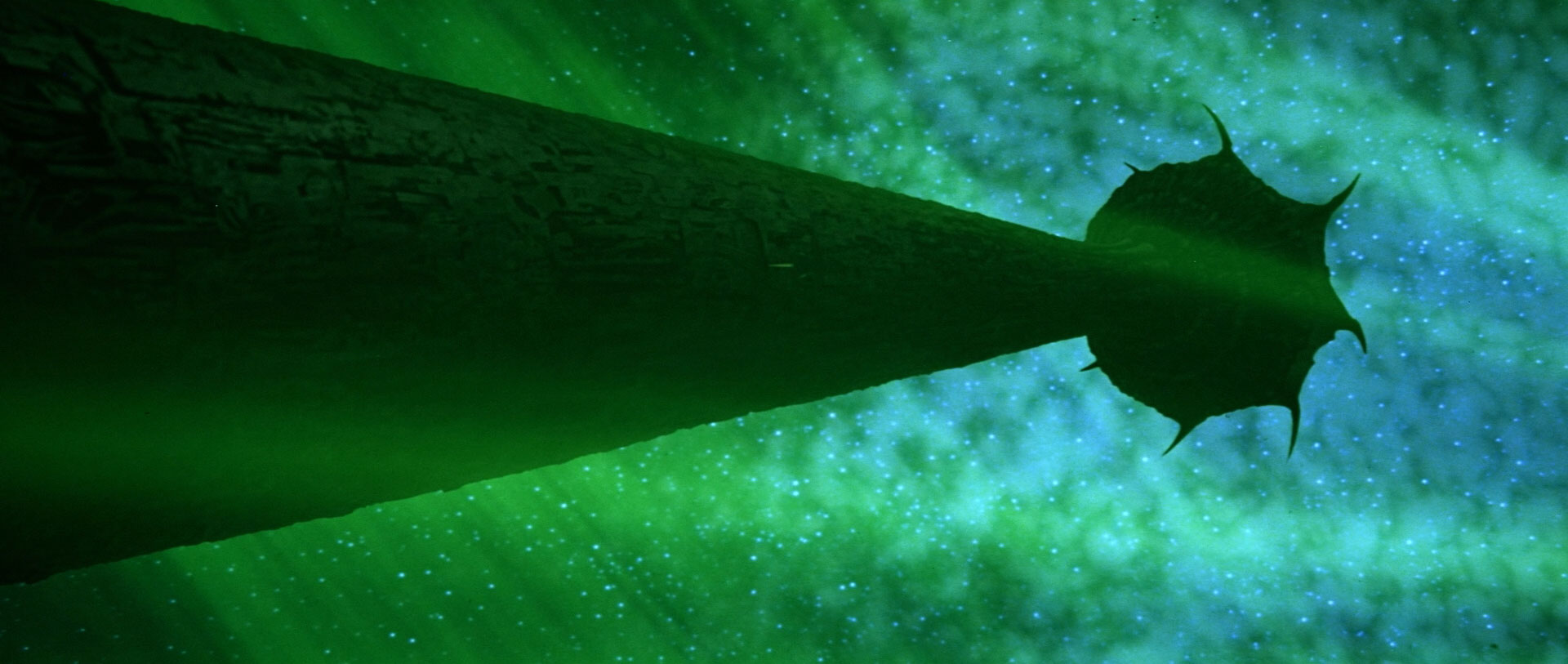
LIFEFORCE

Directed by Tobe Hooper.  Written by  Dan O'Bannon and Don Jakoby.  Stars Steve Railsback, Peter Firth, Mathilda May.
1985, 116 minutes, Color, Not rated.


Ah, what a mess of a movie, yet very watchable throughout thanks to the varied special effects and nudity.  The movie plays like a long-lost Quatermass story, and if it occasionally does not make sense it is more than made up for by the aforementioned nudity and special effects.  Even in the full-length 116-minute version of the film, it moves along briskly, so if you hit something that doesn't work particularly well you are moving onto the next thing soon enough.

The plot deals with ancient space vampires and is part science fiction, part mystery, and part horror film.  These elements do not always mesh together well with the horror elements feeling the most forced.  The movie has a great concept and this carries the day for quite a while into the running time, but ultimately it degenerates into little more than a zombie movie.  I used to think I didn't like Steve Railsback in the film because I thought he was miscast, but I've changed my mind.  All things considered, I think he did quite a good job, and that many a different actor would have completely embarrassed themselves. 

The DVD was among the earliest releases and is not 16:9 enhanced.  As a result, the image is grainy and somewhat fuzzy, though the 5.1 sound is a definite improvement over the LD.   More recently, MGMHD has shown a truly beautiful Hi-Def version of the longer European cut several times.   For that matter, they've also shown the shorter R-rated 101 minute version in Hi-Def. The full version offers more explanation, doesn't plaster credits over the alien ship's approach and penetration at the beginning, and is the preferred version.  The image is crisp and colorful and greatly enhances the viewing experience.  Truly, a quality presentation will almost always make a mediocre movie enjoyable.  Screen captures are from the HD version.