Showing posts with label Mystery. Show all posts

Sunday, July 5, 2026

Eyewitness (1981) Novelization


Written by John Minahan.  The film was written by Steve Tesich and directed by Peter Yates.  It starred William Hurt, Sigourney Weaver, Christopher Plummer and James Woods. 

This is not your typical novelization. It's written in the first person from the main character's perspective (William Hurt) and uses what could be described as a method-acting approach. The opening chapters are a deep dive into everything about the main character and is so divergent from the final film that I initially thought that the author used an early, radically different version of the script. The first-person narrative imposes changes on the story, as the book only recounts what the main character experiences. As a result, some scenes featuring Sigourney Weaver's character are omitted; they are covered in dialogue later to maintain continuity. The book eventually veers into the lane that aligns more closely with the final film. This was an interesting approach and it made me want to see the film again.

From the back cover:

If he had seen the killer, he'd know why the killer wants him dead.

EYEWITNESS.

Daryll Deever didn't see a thing that night. But whoever brutally snuffed out the diamond dealer in Daryll's building obviously thinks Daryll knows too much. So do the police. The only thing Daryll does know for sure is that his best friend had a strong motive for murder. But if his friend did do it, why does he also want to get rid of Daryll? And why resort to such sadistic means? The one hope left in Daryll's life now is TV newswoman Tony Sokolow. And Tony is closer to the killer than she thinks. So very close, in fact, that his next move will bring him near enough to kill again.

Somebody Killed Her Husband (1978) Novelization


Written by Clyde Phillips.  Based on the 1978 film written by Reginald Rose and directed by Lamont Johnson. It starred Jeff Bridges, Farrah Fawcett-Majors, John Wood and John Glover.

It wasn't until I looked into this film that I found out that Fawcett was originally cast in FOUL PLAY (1978), but due to contract issues with Aaron Spelling over Charlie's Angels, she was not able to do it. Goldie Hawn got the role instead. That is a shame because Fawcett would have been good in that film, which while not a great movie nevertheless was successful, which is more than can be said of Fawcett's first couple of big-screen starring roles. Her first three films were SOMEBODY KILLED HER HUSBAND (1978), SUNBURN (1979) and SATURN THREE (1980), which all flopped. SUNBURN is a bad movie and Fawcett is not particularly good in it. She is much better in SATURN THREE, but it is SOMEBODY KILLED HER HUSBAND that really showed her promise. She is luminous in the film and one can't help but think that if she had better material her career would have turned out differently.

This is not to say that SOMEBODY is a good movie. It has a plot that requires a balance between playfulness and seriousness to truly work. The movie is all over the place tone-wise, playing it much too broad when it needed to be more subtle, and too subtle when it needed to be broad. It also has an inappropriate music score that throws off the tone. Bridges and Fawcett are quite good and show an easy chemistry that is ultimately squandered, and the whole thing ends up being fairly ridiculous.

The novelization does a much better job of maintaining a tone which gives the material more of a chance to work, and for the most part it does. Whereas you grow irritated with the illogical actions of the characters in the film, I was able to go along with it in the book, which is full of additional detail and character insight.

Excerpt:

Although hundreds of kids and parents swarmed all over the floor like bugs conquering a picnic, Jerry caught the slightest glimpse of one particular woman through the crowd and, for the first time that morning, stopped talking to himself. It was her hair. The first thing he could see clearly as he raised up on his toes was her hair. She was on the other side of the department and a sea of bobbing heads separated them, but Jerry's eyes locked on her and could not be averted. The natural flow of the crowd was carrying her toward him.

The hair. Full, blonde, with a few delicate hints of a darker beige suggested throughout, swirling in healthy, vital waves to her shoulders. As she worked her way closer, Jerry was able to get a better look at the woman beneath the exquisite hair. The glimpse gave way to an out-and-out stare as he stood in reverent appreciation of a truly singular beauty.

Her face was classically drawn. High, proud cheekbones, flawless skin and a tiny, aristocratic nose. Soft lips and perfect teeth that seemed to be illuminated from within. A proper beauty; the girl of any man's dreams. Jerry felt divinely privileged just to be allowed to look for a while and remember this moment forever.

As she wandered through the shoppers, Jerry noticed that, for all her exquisite appearance and posture, she was dressed rather simply. Washed-out jeans, a pink T-shirt under a blue workshirt tied at the waist. White tennis shoes and no belt. Her only concession to fashion was a navy blue Anne Klein scarf tied loosely around her neck, almost as an afterthought.

When she finally emerged from the milling people, Jerry saw that she was not alone and he sighed. It figured. Not that he had the slightest chance of ever getting to know someone like her, but the ten-second fantasy that had just raced through his mind would have lasted him a couple of months.

Saturday, October 18, 2025

Klute (1971) Novelization


Written by William Johnston.  The film was written by Andy Lewis and David E. Lewis and was directed by Alan J. Pakula.  It starred Jane Fonda, Donald Sutherland, and Roy Scheider.

Klute is a reasonably effective mystery bolstered by an Oscar-winning performance by Jane Fonda.  She really is very good in this, and together with her Oscar-nominated role in They Shoot Horses, Don't They? (1969), she was on something of a tear in the early 1970's.  Acting-wise at least.  She was also becoming known for her politics, but her acting in these two films back-to-back is impressive. 

The film was the second to be directed by Alan J. Pakula, and it is the first to fully realize Pakula's "stylized documentary" approach, which is full of close-ups and off-kilter shots.  Cinematographer Gordon Willis was a big part of that, and Klute is visually impressive.  The sense of menace that the film generates is perhaps not quite to the level that Pakula was able to achieve with his next two films, THE PARALLAX VIEW (1974) and ALL THE PRESIDENT'S MEN (1976) but you can tell this was made by the same person.  

This novelization hews very closely to the screenplay, which is in turn very close to the final film.  There are a couple of differences but nothing particularly noteworthy.  There is a psychiatrist character who is female in the film, but male in the screenplay.  The ending was improved in the film as opposed to what is here--not of the mystery but with how the two lead characters' relationship is depicted.  The author of the novelization resorts to presenting dialogue as in a screenplay format too often.

Nothing is illuminated through the novelization process, but it reads pretty well.

From the back cover:

Klute was a cop from Pennsylvania. Bree Daniel was a New York call girl. They met when Klute came to the city looking for his best friend. Bree was his only lead but she couldn't remember the man. Or so she said. Her world of sex and hard drugs fascinated and repelled Klute. Its wanton cruelty represented everything he hated about the city.

But as Klute and Bree chased the missing man through New York's depraved underground society they found themselves drawn irresistibly together.

And then the killer appeared...  

Excerpt:

Carrying his suitcase, Klute stepped out onto the New York City street from the subway, then paused and looked about, uncertain as to which direction to take. After a moment, he sighted the street sign he was looking for. He set out, checking the addresses of the brownstones along the way.

This was the part of the city that was rarely mentioned in the travel folders. Garbage cans at the curbs, litter and dog droppings in the gutters, dim lights, downcast eyes and sullen faces. It was the part that made him appreciate most the green mountains and fertile fields of Pennsylvania.

A few blocks later, Klute reached the address he was seeking. Again, he halted. Squinting through the dimness, he peered at the For Rent sign in the window of the basement-level shop, then looked up toward the light that came from the window of the top floor apartment. Moving on, he ascended the steps to the foyer. After locating Bree Daniel's name on her mail box, he entered the building and climbed the stairs to the top level. When he reached her door, he knocked.

The peephole opened. Then a female voice, sounding annoyed, spoke from inside. "What is it?"

"Miss Daniel?" Klute said.

"So? What do you want?"

"My name is Klute---John Klute---"

The door opened approximately three inches. He could see enough of Bree Daniel's face to recognize it from the photograph he carried in his suitcase. Klute put his hand against the door to push it open. There was a crunching sound as it was stopped by the chain-lock.

Klute felt somewhat embarrassed, as if he had been caught trying to break and enter.

"Can I talk to you?" he said.

"What about?" Her manner was cold, suspicious.

"My name's John Klute."

"You said that."

"I'm an investigator," Klute told her. "I'd like to ask you some questions about Tom Grunemann."

"Who?" she asked, frowning.

"Tom Grunemann. He wrote you some letters."

"Geeeee . . ." she replied, forcing a slight smile, pretending innocence.

"He was a research engineer at the Tuscarora Laboratories in Pennsylvania," Klute went on. "He disappeared. I've been hired to look for him.

"Lucky you," she said. "Everybody ought to have something to do." She started to close the door---but Klute had a foot against it. "Believe me, he's not here," she told him.


Sunday, September 21, 2025

Night Games (1980) Novelization


Based on the 1979 film written by Anton Diether and Clarke Reynolds and directed by Roger Vadim. It starred Cindy Pickett, Barry Primus and Joanna Cassidy.

I had never heard of this film before coming across the novelization, and after tracking it down and watching it, I see why. It is not a good movie. I am not even sure that the screenplay had the makings of a good movie.  Whatever drew everyone to this project, it does not come across in the final product.  Vadim complained that the producers recut the movie after he finished it, which may account for the final result. Maybe. Parts of it are certainly better than others, but aside for a couple of things, the movie is utterly forgettable.  The acting by all involved is poor, although I am not sure who could have made the dialogue believable. 


The plot: A woman who suffers from PTSD due to a rape cannot be intimate with her husband. While he is away, she starts to fantasize about having sex with a mysterious masked stranger late at night. Or are they fantasies? When someone breaks in and tries to rape her again, the mysterious stranger turns out to be the drunken author who was also staying at her house. (It's a big house.) The author sends the would-be rapist packing. The entire ordeal—late-night sex and attempted rape—cured her of her PTSD.


The only interesting things about the film are that it stars Cindy Pickett, the creepy actor who played the killer in 10 TO MIDNIGHT (1983) plays a creepy rapist, and the music score.


Cindy Pickett is perhaps best known for playing Ferris Bueller's mother in FERRIS BUELLER'S DAY OFF (1986).  She was on St. Elsewhere and did a fair amount of television work.  Nothing else in her filmography was as overtly sexual as this role.  Gene Davis was pretty effective as the nude killer in 10 TO MIDNIGHT.  He is less effective here, but is still creepy.


Somehow they got the great John Barry to write the music. What works in the film works because of his music. It almost makes it worthwhile watching. Almost. The film's soundtrack includes the following titles: Descent into Decadence, The Lesbian Tango, The Wet Spot, Phantom of the Orgasm. Seriously, the music is good, which makes one or two of the sequences work almost decently.

The novelization is much expanded over the film. It throws a lot more melodrama and sex into the proceedings that are way more effective than anything in the movie. It's not good exactly, but it's certainly much better than the movie. So, win?

Excerpt (best read with the lush music of John Barry in the background):

Dreamily, half-knowing what she did, she opened unfocused eyes and stared into the mirror. Then a slow smile, implicit with the luxury of triumph, spread over her face. For he was there as she had known he would be. The demonic feathered features gazed over her shoulder, and the mouth that she could barely see in the shadowed light, smiled into the mirror. Her own smile deepened in return. It was the smile of a woman who knows she can call her mate to her at her will, for he desires her and her alone.

Her blood was raging in her veins, demanding his touch, but when it came it was as soft as a whisper---just the lightest finger placed against her shoulder and run gently down to her wrist. Light as it was she felt as if he had seared her.

With his every caress a fork of fire seemed to shoot through her. He had come close to her now, his breast leaning gently against her back. Like her, he was naked except for a long dark cloak clasped about his neck. She felt his hands come round her waist, sliding downwards over her satiny skin until they touched the tops of her thighs and rested there. A tremor ran through her and she moaned in sweet agony.

She threw her head back against his shoulder while her hands grasped his. At first he tried to draw them away but she would not be resisted and pulled his hands inwards to the depths of her, leaning against him as if she would collapse.

With a convulsive movement she released his hands and turned to face him. Her eyes tried to pierce the mask, but only his mouth was visible, and that was in shadow. No matter, she knew Jason's mouth. It was on hers now, all else blotted out as she felt herself drawn towards him in an embrace that enveloped her under the cloak. She was vanishing into darkness as the cloak was wrapped around her, swallowing her up. But this was how she wanted to be swallowed up---in this whirlpool of feeling that left no room for any sensation but sensuous joy and rapture.

His body was hard and smooth against hers. His hand in the small of her back was pressing her imperiously towards him so that she could feel his desire as powerful as her own. And then the hand was gone, an arm tightened under her shoulders and she felt herself held high in his arms. She had one last look at his face blazing above her with the pride of conquest. The sight was too much for her. She flung an arm round his neck and buried her fade against his breast as he carried her out of the studio and started up the stairs. . .

Monday, December 21, 2020

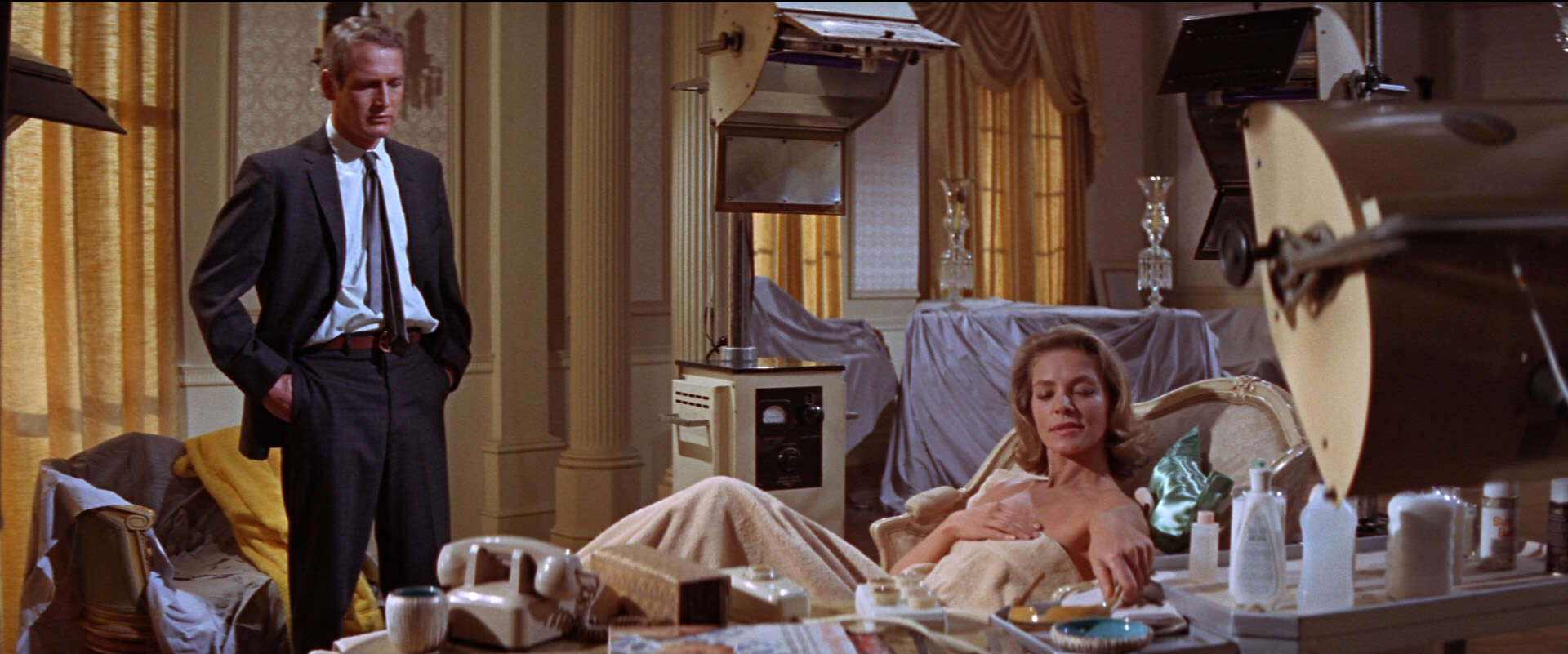
HARPER

Directed by Jack Smight.  Written by William Goldman.  Stars Paul Newman, Lauren Bacall, Julie Harris, Arthur Hill, Janet Leigh, Robert Wagner, Shelley Winters, Strother Martin.  
1966, 121 minutes, Color, Not Rated.


HARPER is based on the first of the Lew Archer" series of books by Ross MacDonald.  The film version had a screenplay written by William Goldman, who had written only one movie prior to this but had written several books.  He later credited this film as being the one where the lightbulb went off in his head about screenwriting, and that he would be successful at it.  He was, in fact, very successful at it and would later write such films as BUTCH CASSIDY AND THE SUNDANCE KID (1969), PAPILLON (1973), THE GREAT WALDO PEPPER (1975), MARATHON MAN (1976), ALL THE PRESIDENT'S MEN (1976), THE PRINCESS BRIDE (1987), MISERY, and MAVERICK.  He was also gainfully employed as a script doctor.


The film is remarkably faithful to the book, but it has been judiciously edited to be more streamlined.  In this way, Goldman proves that he understands movie plotting, innately (apparently) understanding what can be glossed over and what needs to be shown in detail.  The plot involves a missing husband.  Newman plays Lew Harper (changed to Lew Archer for some reason), a private detective hired by Albert Graves, the lawyer of the man who's gone missing.  Harper is a bit of a sad sack, but as we ultimately see is pretty good at his job.

The film is stylishly made but almost undone by its desire to be topical--it wallows in the Hollywood vision of the hip and swinging 1960's and this ultimately dates it badly; Go-Go dancing is featured entirely too much for this to be a timeless entertainment.  By contrast, the novel is not nearly as locked in time even though it was originally published in 1949 and is awash in all kinds of post-war ennui.  Graves and Archer/Harper are not quite close enough in age for their friendship to make sense in the film, but the novel clarifies that they served together in the war, which feels right. 

Aside from Newman, the cast is full of lead actors of a somewhat faded luster, as well as some competent character actors.  Lauren Bacall, Shelley Winters and Janet Leigh do the best with their roles, but Robert Wagner and Strother Martin also score in secondary roles.  Casting less old-school Hollywood faces may not have helped the film, but I can't really say anyone is bad in it.

Newman was active in the 1960's--HARPER is one of seven films he appeared in that were released from 1966-1969.  All of these films are interesting roles for Newman, with the standouts being HOMBRE and COOL HAND LUKE (both 1967).   He is interesting even in the misfire films, like TORN CURTAIN (1966).  Newman was uncommonly subtle in his craft by this point in his career which no doubt cost him some acting awards, but his work was way above average.  A method actor, much of his work is internal, and was not helped by his preference for playing strong silent types whose actions ultimately tell the audience what kind of person his character really is.  


In HARPER he keeps everything close to his vest until the very end of the story.  Newman is quite good in the role, bringing a lot of reality to the proceedings.  He is consistently behind the curve plot-wise so the majority of what he does is reactive, but that is exactly his strength.   He plays the sad sack well--so much so that the majority of the people he interacts with consistently underestimate him.  When the time comes, Harper brings the goods in much the same way that Eliot Gould's Philip Marlowe does in Robert Altman's THE LONG GOODBYE (1973).

While Newman would return to the role nine years later in THE DROWNING POOL (1975), his work in this film should have been the start of more than it was.  As it turned out, this film wasn't the hit everyone wanted.  He would score with COOL HAND LUKE (1967) the following year, but big box office success would not come until BUTCH CASSIDY.


Still, the plot is intelligent, the characters are interesting, and the mystery well handled.  Jack Smight directs with style and the widescreen cinematography by Conrad Hall is fabulous. I especially like how Smight uses long tracking shots in the film.

Warner Archive released an outstanding Blu-Ray of this a few years back.  It features a commentary by William Goldman that originally appeared on the DVD.


Wednesday, May 23, 2012

MARNIE

Directed by Alfred Hitchcock.  Written by Jay Presson Allen.  Stars Tippi Hedron, Sean Connery, Diane Baker.
1964, 130 minutes, Color, Rated PG. 


MARNIE was among the last of Hitchcock's films that I saw.  I avoided it for many years thinking, incorrectly as it turned out, that it would not interest me.  Critics seem to be pretty divided on it--either they think it a total misfire, or that it is Hitchcock's last masterpiece.  Truffaut calls it a "flawed masterpiece", and Daniel Spoto dispenses with the "flawed" appellation and flat out calls it a masterpiece.    As far as I 'm concerned, I find myself squarely in the masterpiece side of things.  It is undeniably old-fashioned, and this was held against it when new, but as more time passes it is easier to accept it for what it is.  


Hedron is very good in a largely unsympathetic role.  Her performance is full of hard edges and is a little bit shrill, but that is what the role was so I have a hard time faulting her for it. Grace Kelly considered coming out of retirement to play the role but ultimately decided not to.  With her in the role the movie would have been different as I think she would have been softer and thus more sympathetic. 


This was the last time that Hitchcock worked with his usual crew; his director of photography and editor would both die suddenly after this movie, and Hitchcock would fire Bernard Hermann from TORN CURTAIN (and Hermann provides a majestic, lush score for MARNIE).  Because the crew of this film has been together for so long there is an elegance to the execution that is truly exciting to see.  Albert Whitlock provided matte paintings for the film, and from an effects standpoint MARNIE is much more assured than THE BIRDS.  We are usually aware when we are seeing an effect in THE BIRDS, in MARNIE the opposite is true.  That said, the rear-process work in this film is horrible, and the reason is hard to ascertain.  Was it because Hitchcock had lost interest in the project by the time they came to be filmed?* Or just an assumption that movie audiences of the day wouldn't care?


Still, for sheer cinematic effectiveness the overall picture stands amongst Hitchcock's best, and surprisingly stands as the logical progression from THE BIRDS, which I always found experimental in construction and execution.  MARNIE is perhaps more experimental in that the characters do not operate on logic, but instinct and emotion.  I suppose this is why so many critics found it silly back in 1964.  I thought it was just grand.

*There is an oft-repeated tale that Hitchcock propositioned Hedron during the making of the film, she rebuffed him, and he lost interest in the film.  Certainly, there is an unevenness to sections of the film suggesting to me that Hitchcock rushed through scenes simply to get them over with (which is why Truffaut calls it flawed),