Showing posts with label Sean Connery. Show all posts

Sunday, July 5, 2026

The Untouchables (1987) Novelization


Chicago. . . the 1930s. . . gangsters. All the action, all the violence, all the good guys and bad guys that made The Untouchables one of the most popular TV series comes this summer in paperback and on the big screen. The Untouchables is sure to do for the movie tie-in business what Elliot Ness did for Chicago--clean up! The movie stars Robert DeNiro, Kevin Costner and Sean Connery and is scheduled for release June 5, 1987.

***

The author of the novelization is a long-time mystery writer, so he does a decent job of fleshing out the characters and telling the story well.  It is obviously based on an early draft of the script, and lacks the great style that director Brian DePalma brought to the film.  Still, a good read and fills in much detail that is not in the film.

The Wind and the Lion (1975) Novelization


Written by John Milius
1975 Award Books paperback edition.

Based on the 1975 film THE WIND AND THE LION, written and directed by John Milius. It starred Sean Connery, Candace Bergen, and Brian Keith.

I have not watched this movie in a great many years, but I remember liking it quite a bit. I don't remember the movie well enough to know how close the novelization is to it. According to Wikipedia it is slightly different from the film, with a few extra scenes.

It is a short book, but effective.

Saturday, September 27, 2025

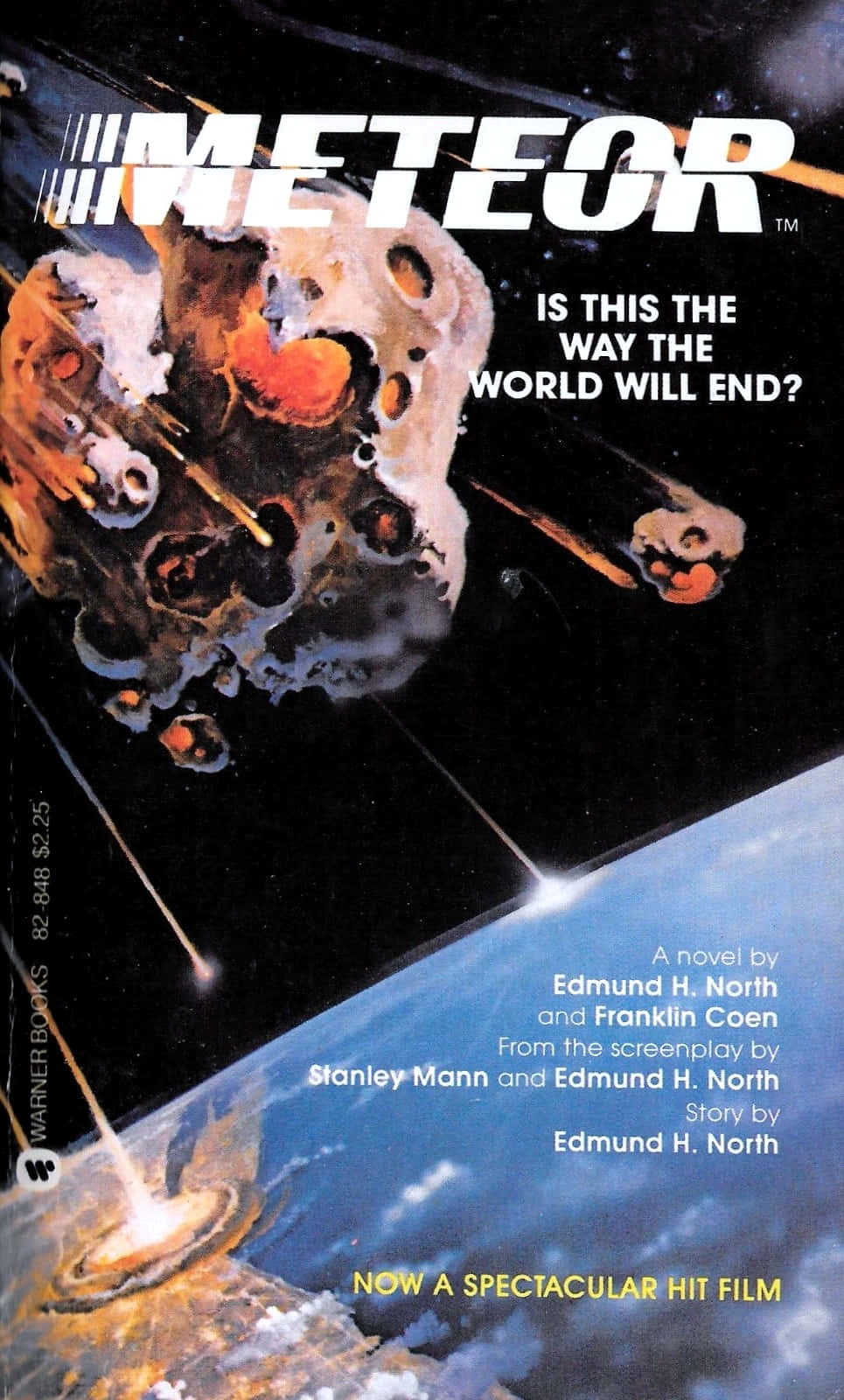
METEOR (1979) Novelization


Based on the 1979 film written by Edmund H. North and Stanley Mann. Directed by Ronald Neame. It starred Sean Connery, Natalie Wood, Karl Malden, Brian Keith, Martin Landau, Trevor Howard, Richard Dysart and Henry Fonda. The book is credited to Edmund H. North and Franklin Coen. I have a draft of the screenplay dated October 19, 1977 that is credited only to Stanley Mann.  I believe that this novelization is based on that draft.

METEOR was one of the last of the disaster films made in the 1970's and while the film itself is disappointing it nevertheless has a lot of positives. From a story standpoint, the film tells its story grounded in realism and avoids melodrama—this is more DEEP IMPACT than ARMAGEDDON. The emphasis is on character. There is spectacle but plot-wise it is organically handled. In many ways the film should have been an outstanding example of the genre, differentiating itself from things like THE TOWERING INFERNO and EARTHQUAKE and falling closer to ON THE BEACH.

Alas, the film is ultimately a miss. Too often the film presents us with details that take you out of the story. Some of the details are scientific—early in the film a conversation is shown between Earth and a manned spacecraft in the vicinity of Mars. The conversation is shown as being real-time whereas in reality there would be a considerable lag (6 to 22 minutes depending on where the craft was) between the two sides. Am I picking nits? Perhaps, but the filmmakers talked about scientific accuracy in the press so I think it's a fair point. Additionally, there are moments in the film where views from outer space are shown on video monitors with no explanation as to how they are being produced. Are both quibbles a result of narrative shorthand? Sure, but again, they went on about how accurate it was in the press. . .

And I guess WAS accurate. . .for a 1970's disaster film that is.

The above is minor, and I could have happily lived with it if not for the film's major failing—the special effects. For whatever reason, they were not able to get anyone to handle the visual effects competently. Just about every shot of the titular meteor is a bad optical and every shot of the orbit-based missiles are bad miniatures. The scenes of destruction are usually the raison d'ĂȘtre for a disaster film, and these are just as badly handled. There is a scene of an avalanche in the alps that reuses footage from the 1978 low budget film AVALANCHE.

What's astonishing is that the filmmakers delayed the release of the film in order to have the visual effects redone. This decision was made after filming was complete and, reportedly, after the film was "done". The original effects team was fired; a new team came in who also struggled to deliver the effects. Very late in the day yet another team was brought in. Considering how poor the effects that made the film are, it makes you wonder how bad the original effects were.

This is a shame. Money was obviously spent on the film. The cast is good, the story is inherently dramatic. If the effects were at least decent it would be a lot easier to take.

The novelization corrects all of the flaws of the finished film. Characters are more fleshed out (Sean Connery's character is a professor at Columbia, for instance), the science is more realistic, one is not constantly taken out of the story by obvious model work. There is more political shenanigans (wisely left out of the film but not unwelcome here), and the Connery and Wood's character have a full blown lover affair. It's all well-handled and is the ideal version of the story.

Friday, August 13, 2021

The Great Train Robbery

The Great Train Robbery
Directed by Michael Crichton.  Written by Michael Crichton.  Stars Sean Connery, Lesley-Anne-Down, Donald Sutherland,   
1978, 110 minutes, Color, Rated PG. 


Michael Crichton had an interesting film career in the 1970's. His first job as director was the television movie PURSUIT (1972) which was based on his novel Binary (published under his 'John Lange' pen name).  PURSUIT is a perfectly fine little film but it doesn't really point to any great talent. His first big-screen film was WESTWORLD (1973) based on his original screenplay, and was a corker of an idea executed far better than the meager budget allocated to it would have predicted.  Blessed with an above-average cast (especially the stunt casting of Yul Brynner as a robot), WESTWORLD shows some real flair for film storytelling.  Crichton moved on to other projects after WESTWORLD, namely writing The Great Train Robbery (1975) and Eaters of the Dead (1976), but returned to filmmaking when he accepted the directing and screenwriting chores for COMA (1978), which was based on the novel by Robin Cook. COMA is quite effective and fits in nicely within his oeuvre, even though it was not his original idea.  Along with PRIMARY EVIDENCE (1989), ROBBERY stands apart from Crichton's other films by lacking any science fiction elements. 


THE GREAT TRAIN ROBBERY (1978) is an old-fashioned adventure tale based on fact and blessed with sparkling performances by Sean Connery, Donald Sutherland and Lesley-Anne Down. The film is set in London in 1853 and does a good job of depicting this thanks to the opulent cinematography by Geoffrey Unsworth.  The bulk of the running time is taken up with Connery's plan to plan and execute the world's first robbery on a moving train.   The robbery itself occurs over the last twenty-some minutes.  The plan involves copying four keys to open safes on the train that contain gold bullion while the train is moving.  In 1855, no one had ever successfully robbed a train in motion so it was a big deal at the time.  

Sean Connery plays Edward Pierce, mastermind of the plan.  The film shows the steps that led up to the robbery and the robbery itself.  The film compresses and slightly rearranges the events but remains faithful to the source novel. Those involved in the robbery were caught in 1857 and put on trial, but Pierce escaped and presumably lived out his life in luxury, as the money was never recovered.  Since all the pertinent facts of the story come from the trial transcripts, if they had not been caught, we would have no real way of knowing how it was done.  

Crichton states in the novel that he took all the dialogue from the trial.  It lends an aura of authenticity to the book, but ultimately becomes its biggest problem, as almost nothing is known with certainty about Edward Pierce.  Given the lack of confirmable information that is available, it is not even entirely clear that this was his real name.  Therefore, everything we know about him comes from what others said about him, and we know he lied to them.  Crichton largely overcomes this issue in the novel by layering in much detail about the time period in which the story is set.  It's a great read and very entertaining.  The film cannot spend so much time on the context of the events, but between Connery's charisma and the excellent production design, the film moves along in a way that you aren't really aware of the lack of true understanding of Pierce.

Other changes from the novel and film:
  • Two people are combined into the character that Sutherland plays.  He is a pickpocket and "screwsman" (someone who makes copies of keys) in the film; in the novel, he is just the screwsman, with another person being the pickpocket.  
  • One of the keys has to be obtained from Mr. Henry Fowler, who in the film is a lecherous bank executive who carries one of the four keys needed to open the safes that contain the gold.  Pierce is able to copy the key by setting him up with a prostitute (played by his accomplice Lesley-Anne Down).  There is subterfuge involved and Down's character does not have to actually do anything with the man.  In the novel, he is still lecherous but suffering from the effects of a venereal disease.  Pierce sets him up with a prostitute who is a virgin (and frightfully young) and is able to copy the key while they are engaged in their activities.
  • In the film, Pierce is caught at the station directly after the robbery.  He is put on trial and convicted but escapes as he is being led from the courthouse with the help of Down's and Sutherland's character.  In the novel everyone gets away.  However, two years later Sutherland's character is brought in by the police after a woman he knows tells them that he had a part in the gold robbery.  He eventually gives up Pierce and this is how everyone is caught.  Pierce still escapes, but Sutherland's character ends up in jail.

Just when things start to drag a bit too obviously--somewhere around the act of copying the fourth key--the film finally gets to the robbery itself.  Up until this point, the film was lightweight, agreeable and mostly fun, but the train sequence elevates the film and is far and away the most impressive thing that Crichton ever filmed.  Connery was just shy of 50 when he made this film, which makes his decision to do all of his own stunts on the train impressive.  The film shows him climbing onto the roof of the moving train without a safety harness, which is astonishing.  When Connery is almost taken out by low bridges several times it truly appears as though he was in real danger.  In his book Travels, Crichton explains that these scenes were carefully planned out which makes the execution all the more impressive, at least from a cinematic standpoint.


This is not to say that Connery was not in real danger at times.  Crichton also relates in Travels how the train was supposed to stay at 35 miles per hour, but as it was a period train there was no speedometer.  The engineers estimated the speed the best they could by counting how many telephone poles they passed in a minute.  Later, the helicopter crew confirmed that for at least one of the sequences the train was in fact going closer to 55 miles per hour.  This gives the film an element of danger that it probably doesn't deserve.  Still, an agreeable film that has always been a personal favorite.

I watched it this time on the Kino Lorber Blu-Ray.  It's an older transfer but looks decent enough.  The disc includes Crichton's audio commentary, originally on the MGM/UA laser disc.  Crichton is an intelligent speaker and it's a great commentary.

Friday, December 7, 2012

THUNDERBALL

Directed by Terrence Young.  Written by Richard Maibaum and John Hopkins.
Starring Sean Connery,Claudine Auger, Adolfi Celi, Rick Van Nutter, Molly Peters, Martine Beswick
1965, 130 minutes, Color, Rated PG, Panavision 2.35:1


The major television networks in America don't really show movies anymore, which is a shame.  Granted, there is the occasional showing during holidays, but for the most part the cable movie channels have removed the specialness of watching movies on network television.  For that matter, TV channels used to fill airtime by showing movies but now mostly fill their off-hour airtime with infomercials.  With cable movie channels running movies 24 hours a day without commercials, perhaps the day of networks showing movies is justifiably past.  But I still kind of miss it.   Mind you, I would never watch a movie on network television at this point. Aside from the commercial interruptions I wouldn't be able to handle the content editing, or even the aspect ratio fudging for 2.35:1 films.


Still, back in the day when TV ruled home entertainment networks made an effort to make broadcasting a movie seem like an event, something that is just a distant memory now in this age of having hundreds of channels to choose from. Consider the Channel 9 (WOR-TV) "Million Dollar Movie" with its montage of New York City set to the theme from GONE WITH THE WIND.  It was  regal and set up whatever came on after it beautifully.  I can't tell you how many Saturday afternoons I spent watching Channel 9.   Or consider Channel 48's (WKBS-TV) "Creature Double Feature" with that great hand that comes out of the grave.   How could you not love whatever came on after seeing that intro?   EQUINOX, THE WORLD, THE FLESH AND THE DEVIL, THE BLOB, BEWARE THE BLOB, THE CRAZIES--I saw all of these at too young an age on channel 48.  Best of all was the Channel 5 Movie Club, which aired on WNEW-TV in New York (before it became a Fox channel).  It came on at 11:00 pm Saturday nights and they showed "good" movies with fewer commercials and more uncut than usual.  I saw STRAW DOGS and MISTER ROBERTS for the first time on the movie club, and STRAW DOGS had all of its topless nudity intact.  I wish I could remember more of the movies I first saw on that channel.

Right up there, for me anyway, is the ABC Sunday Night Movie.   When ABC showed the Bond films, everything about it screamed EVENT.  We had the promo commercials leading up to it during the week, the thrilling opening sequence, and best of all a warning that viewer discretion was advised.


The first two Bond movies, DR. NO (1962) and FROM RUSSIA WITH LOVE (1963) were solid successes--both had small budgets and both grossed impressive numbers worldwide.  GOLDFINGER (1964) had a larger budget but grossed much more than the previous two.  It became a worldwide sensation and sparked a flood of super-agent films, television shows, and books.  The next Bond film was given a much larger budget and tried to prove to the world that the original was best of all.  The film spanned several countries and featured a large international cast, large-scale action scenes, and not one but TWO beautiful leading women.  Like GOLDFINGER, THUNDERBALL was also a huge hit and, to a large degree, shaped all the Bond films that came after it, both stylistically and specifically in establishing elements that HAD to be part of every subsequent Bond film.  Maurice Binder's title sequence set the pattern for every title sequence that followed in the series.


The plot is fairly complicated for a Bond film, with SPECTRE stealing some nuclear bombs and demanding a ransom from the U.N.  Bond is assigned to investigating a lead in Jamaica and stumbles on the bad guys in the process.  It's the second appearance of Blofeld in the series, though his face wouldn't be shown until the next Bond film, YOU ONLY LIVE TWICE.  The story was originally co-written by Bond creator Ian Fleming and others for producer Kevin McClory who had wanted to make his own Bond film prior to Albert R. Broccoli and Harry Saltzman buying the rights to DR. NO, but when the movie never materialized Fleming adapted the story as a book.  The problem is that Fleming didn't own the rights to the story, and this led to a lawsuit between McClory and the makers of the Bond films.  The next Bond film had previously been announced as ON HER MAJESTY'S SECRET SERVICE, but McClory was threatening to make his own Bond film.  Rather than allow that to happen--McClory had a valid claim to the THUNDERBALL story as a movie--Broccoli and Saltzman settled with McClory and agreed to make THUNDERBALL instead.  Thus, the world was robbed of seeing Sean Connery in probably the best Bond story of all. In 1964 Connery was still invested enough in the role to have made MAJESTY'S SECRET SERVICE very interesting, to say the least.
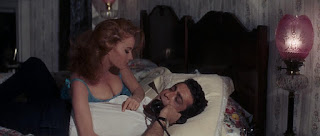

THUNDERBALL is probably the yardstick by which I measure all other Bond films.  It's not a perfect movie by any means but in my view does a lot more right than it does wrong.  The film shows several signs of being a rushed production, with numerous continuity errors and obvious pickup shots.   The worst continuity error is a character that disappears at the end of the film.  Note in the first capture below that Bond, the girl and another man jump from the ship right before it hits the reef and explodes.  Yet when we cut back to the water after the explosion the man is missing and his absence is not commented on.  As Bond and the girl are clearly in a studio tank in the closeups one can only guess that the actor was unavailable several months later when the close-ups were shot.


At one point Bond is talking to Domino on a beach, the majority of which takes place on an actual beach.  An insert shot of them just as obviously on a soundstage sticks out like a sore thumb.


The Bond character occasionally gets lost in the shuffle as the filmmakers try to cover all of the action; he never actively does anything to propel the story forward.  He instead floats along reacting to events he has no control over.  Heck, he doesn't even kill the villain.  This was perhaps not the intent of the makers but was a byproduct of the dramatically larger scope of the film. The underwater scenes involving the downing of the plane, and the big fight at the end consume a huge amount of screen time. The need for the plane sequence can be debated.  Does the film need it to tell the story?  Perhaps not, but it's undeniable that it enhances the film's impact.   The underwater fight sequence at the end is sometimes referred to as "indeterminable" by those who have no patience for it, and I can sympathize to a degree.  It does go on for a hell of a long time, but again, for putting spectacle up on the screen it works just fine.


Given all of that, THUNDERBALL remains my favorite Bond film for several reasons.  It was the first Connery Bond film I "got" as a youngster.  I had seen a few of the films on TV previously--notably THE SPY WHO LOVED ME and MOONRAKER--and weaned as I was on Roger Moore's interpretation of Bond, THUNDERBALL was a revelation the first time I saw it.  For the first time I understood why people were saying that Connery was the best Bond, for in his prime he was truly something to behold.  Brawn and intelligence have rarely combined so seamlessly onscreen, and from a purely physical standpoint Connery was never better as Bond than he was in this movie.  He moves like a caged animal, full of confidence and style, and he is still thin enough to look good without his shirt.


Though to be fair, he doesn't look tip-top in ALL of the film.  It looks to me like Connery showed up in one type of shape at the beginning of shooting and ended up in different shape by the end.  I think the location filming was done earliest as he looks best in these scenes.  When filming moved to the soundstages later on, he had put on more weight and is beginning ever so slightly to take on the paunchy look that would define his look for the next 10-15 years.  In fact, if I were to guess which scenes were filmed absolutely last I would say the fight aboard the Disco Volante was filmed last of all, for he looks the heaviest there.  Then again, maybe it's just angles.


Connery began complaining in the press during THUNDERBALL about how much time and energy it took to make the Bond films, and, if you look closely, you can see a slightly diminished dedication to the performance.   Compare his reaction to the death of Paula in THUNDERBALL to the death of Tilly Masterson in GOLDFINGER, which was just one film prior.  In that earlier film he is genuinely moved by her death, but when confronted by a death of a colleague he barely reacts at all.  There are any number of ways to justify his reaction in THUNDERBALL:  Paula was an agent of her Majesty and so knew the dangers involved, for instance.  Possibly.  However, I think it more likely that the production was moving so quickly at the point of filming that sequence that it was just rushed through.

THUNDERBALL was the first widescreen Bond film and Terrence Young's stylistic sensibilities set the bar for all future Bond films.  The wider frame is used expressively and for effect — characters are consistently spread across the screen, and landscapes are appropriately framed to maximize screen real estate.  It is the first Bond film to FEEL like a Bond film.  Compared to GOLDFINGER, THUNDERBALL is a work of art visually and set the tone for just about every Bond film to follow.  It was an expensive movie and every effort was made to put the money up on the screen, and to a large degree the filmmakers were successful in this for THUNDERBALL has an immense scope to it.

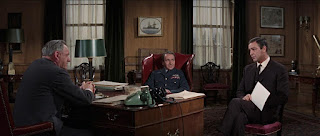

Aiding this sense of "scope" immeasurably are the wonderful sets by Ken Adam.  Whether it be massive indoor spaces or regular sized rooms, Adams' work on the film is impressive, albeit not always practical.  I can go along with the massive meeting room in the MI5 building, but I'm not sure why SPECTRE would need such a large space in downtown Paris.  I particularly like the sea shanty Q later uses in the film and all the hotel rooms.


The cast of THUNDERBALL is top notch.  The women are voluptuous, with Claudine Auger as Domino a particular standout.  She may not have spoken English well, but her initial appearance in the film features a swimsuit that remains a favorite for its peekaboo effect.  Luciana Paluzzi is impressive as an almost impossibly voluptuous agent of SPECTRE, but Adolfo Celi is almost the prototypical Bond villain.  He even sports an eye patch.  The main difference between THUNDERBALL and almost every Bond film that came after it is that the main villain is not a major character.  "Number 1", or Blofeld, is seen to be the man in charge on the bad side but the villains that Bond deals with are underlings that report to him.  Beginning with YOU ONLY LIVE TWICE, the main villain would never again be shunted the background, with a possible exception for CASINO ROYALE and QUANTUM OF SOLACE.


I have strong memories of seeing some of them on ABC around 1979-1980, especially THE SPY WHO LOVED ME and THUNDERBALL.  When ABC showed the movies back then, they didn't (couldn't?) censor the main titles, and there are one or two very clear shot of naked breasts in the title sequence of SPY.  Likewise, there are also naked breasts in the title sequence of THUNDERBALL.  I was 10 or 11 at the time of seeing these films for the first time, do I really need to explain why they appealed to me?  This was the second Bond film that Maurice Binder did the titles for.  The first was DR. NO, and while the titles for that film were interesting it is really here that the title sequence pattern for all subsequent Bond films was set.


THUNDERBALL has been released on home video many times.  The first time I owned it was on laserdisc, and the first widescreen edition came in a gate-fold with only so-so graphics.  It was later reissued in a box set that featured a MUCH better cover and Criterion Collection-level supplements.  Every home video version subsequent to the box set has used parts of it.  The box set was in CAV, featured a soundtrack mixed into surround for the first time, an audio commentary, multiple featurettes and a decent array of still-frame content.  It was, at the time I got it, my all time favorite laser disc.  I never bought THUNDERBALL on DVD until the Ultimate Editions were released in 2006.  It featured a new 5.1 surround mix, more featurettes and an additional commentary.  Visually, it looked good for standard definition.


The Blu-Ray version of THUNDERBALL is easily the best it has ever looked or sounded.  Complaints can be found online about excessive digital scrubbing of the image, but for my tastes it looks great.  I see what the complainers are talking about, it just doesn't bother me that much because when it's all said and done the movie has never looked better.  The film was cobbled together using several different sources, and to a large degree you can't tell unless you are looking closely.

The new 5.1 surround track is NOT the version that was on the Ultimate Edition DVD.  It instead seems to be the track used for the laserdisc way back when.  I no longer have the ability to play a laserdisc but I think it sounds fabulous and really adds to the effectiveness of the film.

Friday, July 20, 2012

OUTLAND

Written and Directed by Peter Hyams.
Sean Connery, Peter Boyle, James Sikking, Frances Sternhagen
1981, 112 minutes, Color, Rated R


A marginal film can be made more enjoyable with a great presentation, and OUTLAND--a marginal film in that it has good performances but is essentially nothing new story-wise--benefits enormously from a great presentation.  Sean Connery plays a Federal Marshall assigned to a remote mining outpost on the IO, the third moon of Jupiter.  There, he finds that the number of people that have gone crazy for no apparent reason is rising.  Could there be nefarious goings-on?

I haven't owned OUTLAND since the laserdisc I bought in the early 90's.  I probably still have it somewhere, but I haven't had a working laserdisc player for a couple of years now so I have to go by memory on what it looked like.  I remember it looking "okay".  It was more notable for being released in widescreen which at the time was still a novelty.  I never got it on DVD because of reviews that said it looked horrible.  The DVD may have used the existing laserdisc master, and  generally speaking laserdisc masters did not port well to DVD.  DVD had an extra 100 or so lines of resolution and was much better at handling colors and so exposed the weaknesses in the older, brighter masters used for laserdisc. An analogous situation is that some HD masters made just a few years ago don't always work well on Blu-Ray.  The technology changes so quickly it's no wonder things get transferred over and over again.*    I never saw the DVD, and I always assumed that it would eventually be remastered and re-released.  It took a little longer than I expected.


The image looks likes film and is DARK, which is as it should be.  Peter Hyams acted as his own cinematographer for many of his films, and right or wrong, he liked to shoot things in a way that almost looks like only practical lighting was used. This is not the same as actually using practical lighting; his films are stylized and it either works for you or it doesn't.  On paper, he wasn't the DP for OUTLAND but for all intents and purposes he controlled the filming of it**.  This results in atmospheric shots that sometimes border on being murky.  I like his style but can understand why one might not especially when the lighting doesn't necessarily match the subject matter, like in RUNNING SCARED, for instance.  His style works perfectly for OUTLAND, however.


The "Hyams" darkness is probably why past video versions have looked so crappy, but Blu-ray has enough resolution to make it work.  The effects look better, and the naturalistic lighting doesn't seem as "arty".   This new Blu-ray is clearly a newer and better transfer than what has been shown on the HD channels in the past and looks very nice.  The improved resolution allows one to take in and admire the sets, and the sound is a tremendous improvement over what has been available for this film in the past.  What's interesting is that Warner's opted for a single layer BD, so it's not like we're talking huge bit rates or anything.  Clearly, someone took time with the transfer.

Perhaps I wouldn't be as impressed with it if it wasn't a film from my childhood.  The plot is relatively simplistic, with no character development to speak of.  I think it tries too much to look and feel like ALIEN and employs questionable scientific accuracy--people wouldn't necessarily explode when exposed to zero gravity in reality, for instance--but dramatically the conceit works fine enough. Peter Boyle is okay in a very poorly written role.  His villain is a gross caricature of a real movie villain, with zero motivation beyond wanting to make money and I find it hard to take.  A more fully realized villain would have served the film well.


All this said I think the good far outweighs the bad.  Sean Connery was still in his prime and gives a thoughtful, physical performance.  The sets are expansive (and expensive) and go a long way toward giving the film an interesting sense of reality.  The design of the visual effects shots are creative and use the Introvision process to good effect. The Blu-Ray features a great 5.1 lossless track that greatly enhances the overall fun factor, especially with improved bass response.  James Sikking and Frances Sternhagen give great performances in supporting roles.

Really...what's not to like?  Great entertainment, at least in my opinion.  HIGH NOON in space?  Yeah, that's about right. I'm still very pleased with this one.

* Warner Brothers Home Video released Blu-Ray editions of CASABLANCA, THE WIZARD OF OZ and GONE WITH THE WIND all around the same time. CASABLANCA has been re-released with a new transfer, and both OZ and WIND have been announced for re-release using new transfers.

** Stephen Goldblatt, the Director of Photographer listed in the credits, largely sat by while Hyams did the real work.  It was his second job as DP and his first Hollywood film.  He hated the experience. See this link on cinematography.com's forum for more.

Wednesday, May 23, 2012

MARNIE

Directed by Alfred Hitchcock.  Written by Jay Presson Allen.  Stars Tippi Hedron, Sean Connery, Diane Baker.
1964, 130 minutes, Color, Rated PG. 


MARNIE was among the last of Hitchcock's films that I saw.  I avoided it for many years thinking, incorrectly as it turned out, that it would not interest me.  Critics seem to be pretty divided on it--either they think it a total misfire, or that it is Hitchcock's last masterpiece.  Truffaut calls it a "flawed masterpiece", and Daniel Spoto dispenses with the "flawed" appellation and flat out calls it a masterpiece.    As far as I 'm concerned, I find myself squarely in the masterpiece side of things.  It is undeniably old-fashioned, and this was held against it when new, but as more time passes it is easier to accept it for what it is.  


Hedron is very good in a largely unsympathetic role.  Her performance is full of hard edges and is a little bit shrill, but that is what the role was so I have a hard time faulting her for it. Grace Kelly considered coming out of retirement to play the role but ultimately decided not to.  With her in the role the movie would have been different as I think she would have been softer and thus more sympathetic. 


This was the last time that Hitchcock worked with his usual crew; his director of photography and editor would both die suddenly after this movie, and Hitchcock would fire Bernard Hermann from TORN CURTAIN (and Hermann provides a majestic, lush score for MARNIE).  Because the crew of this film has been together for so long there is an elegance to the execution that is truly exciting to see.  Albert Whitlock provided matte paintings for the film, and from an effects standpoint MARNIE is much more assured than THE BIRDS.  We are usually aware when we are seeing an effect in THE BIRDS, in MARNIE the opposite is true.  That said, the rear-process work in this film is horrible, and the reason is hard to ascertain.  Was it because Hitchcock had lost interest in the project by the time they came to be filmed?* Or just an assumption that movie audiences of the day wouldn't care?


Still, for sheer cinematic effectiveness the overall picture stands amongst Hitchcock's best, and surprisingly stands as the logical progression from THE BIRDS, which I always found experimental in construction and execution.  MARNIE is perhaps more experimental in that the characters do not operate on logic, but instinct and emotion.  I suppose this is why so many critics found it silly back in 1964.  I thought it was just grand.

*There is an oft-repeated tale that Hitchcock propositioned Hedron during the making of the film, she rebuffed him, and he lost interest in the film.  Certainly, there is an unevenness to sections of the film suggesting to me that Hitchcock rushed through scenes simply to get them over with (which is why Truffaut calls it flawed),