Showing posts with label 70's. Show all posts

Tuesday, August 11, 2026

Dallas (1978) Novelization

Based on the original television mini-series written by David Jacobs, Arthur Bernard Lewis, Camille Marchetta and Virginia Aldridge. It starred Larry Hagman, Ken Kercheval, Patrick Duffy, Linda Gray, Barbara Bel Geddes, Howard Keel, Victoria Principal, Charlene Tilton and Jim Davis.

***

Dallas was an American television series that debuted in 1978 as a five-episode mini-series. It detailed the lives and loves of the Ewing family, and did so well that it was continued as a series. It ultimately ran for fourteen seasons, ending in 1990. Dallas was the prototypical Prime-Time soap opera, and it opened the door to a variety of similar shows in the 1980s such as Dynasty, Knots Landing, and Falcon Crest. Dallas was arguably the best of these and was enormously popular in the early 1980's. If you are of a certain age, the question "Who Shot J.R.?" should resonate. Along the way, it even courted controversy by bringing back a character who had been killed off by declaring that the season that occurred while they were off the show was a dream by one of the characters. I watched the show in the 1979-1983 time-frame and remember it fondly.

What is it one wants from a novelization? They were never meant to be anything other than advertising for whatever movie or TV Show they were based on. In all honesty, most are not good reads. So why do people read them? For me, it was always looking for the experience of the film, but with more. More story, more characterization, more dialog--something that gives more insight into the source material. Some novelizations have scenes that were ultimately omitted from the released version; some are based on earlier versions of the screenplay, so they can differ, sometimes substantially. And some are expanded by the author into something altogether different. This last category is pretty rare. You need a few things to line up for something like that to work: the author has to have the leeway to add new material, they have to be invested enough to add new material, and they have to have the talent to add it.

The novelization for Dallas falls into the last category. The author has systematically revised the world depicted in the screenplays into something earthier, perverse, and twisted.  This is not a world where good and bad are clearly defined—everyone exhibits dark tendencies. It's a world where everyone walks around looking to get it on, and where murder is mentioned casually.  I think it is the author's experience writing erotica that powers this transformation, although this is not to say that the novelization is just about sex.  There are other factors at work as well that complete the reimagining.

Lee Raintree is a pseudonym for Con Sellers, an author who published more than 230 books using more than 60 pseudonyms1. He specialized in adventure, historical romances, and erotica. He was hired by Dell Books to write a novelization of the original five-part mini-series, which he wrote in six weeks. The book was successful, ultimately selling over 300,000 copies by 1979.  He passed away in 19922.

This is very much a product of the 1970s. The men are REAL men, the women are all big-breasted, the language is rough. And my word, there is a lot of sex. Throw in some of the casual staples of the decade as well--misogyny and racism--and you have a rollicking potboiler.

It technically tells the same story as the mini-series, but the author has expanded the parameters dramatically. The book covers all five parts of the mini-series, so you would expect it to be a little longer than typical, but the first 100 pages take place before the mini-series even starts. These first 100 pages are the complete history of the Ewing family--how Jock and Miss Ellie got together and how the family rose to power. This backstory helps set up some plot points covered in the mini-series, but also establishes the world we are going to read about, which is ultimately quite different from the television version. 

You will recognize most of the characters, but there are some divergences as well, and it is in these divergences that the book is most surprising. There are numerous plot points in the book that simply do not exist in the television counterpart. Some of these plot points are character expansions, but some change the overall story being told. I am reluctant to detail them as I don't want to spoil it for anyone who wants to read this, but the world of Dallas depicted in this book is darker, more savage, and ultimately realistic than what could acceptably be shown on television in the late 1970s in America. Murder, rape, extensive profanity, and pretty explicit love scenes abound.

True, the men are misogynistic, but the author is not. He knew who his target audience was--women--and the most dramatic changes made to the story involve the women. They are, with one exception, described as intelligent, strong-willed, and most importantly as women who enjoy sex and are not afraid to admit it. Miss Ellie is shown as a primary partner to Jock in the early years, helping shape how the business grew while she bore him three children. When criminals break into the Ewing house near the end of the story, the television version has the women cowering until the menfolk arrive just in time. The book version has Miss Ellie getting her daddy's Colt .45s and taking care of the criminals herself. Which is entirely fitting given the backstory established in the book, and which is completely absent in the television version.

I am not saying this is high art but it is consistently readable, entertaining and tells the source story much better than the TV show itself.  You can't can't ask for more than that. 

1. https://lib.usm.edu/spcol/exhibitions/item_of_the_month/iotm_sep_2013
2. https://www.lmtribune.com/obituaries/author-con-sellers-dies-at-69-6383c41c

Sunday, July 5, 2026

Last Tango In Paris (1972) Novelization


Last Tango in Paris (Italian: Ultimo tango a Parigi; French: Le Dernier Tango à Paris) is a 1972 erotic drama film directed by Bernardo Bertolucci. The film stars Marlon Brando, Maria Schneider and Jean-Pierre Léaud, and portrays a recently widowed American who begins an anonymous sexual relationship with a young Parisian woman.

The film premiered at the New York Film Festival on October 14, 1972, and grossed $36 million in its U.S. theatrical release, making it the seventh highest-grossing film of 1973. The film's raw portrayal of sexual violence and emotional turmoil led to international controversy and drew various levels of government censorship in different jurisdictions. Upon release in the United States, the MPAA gave the film an X rating. United Artists Classics released an R-rated cut in 1981. In 1997, after the film became part of the Metro-Goldwyn-Mayer library, the film was reclassified as NC-17.

***

As a novelization it hews pretty closely to the script, and offers some backstory not found in the film.  It does not adequately convey the power of the film, but it is interesting nonetheless.

The Bad News Bears (1976) Novelization


The beer-guzzling big league has-been --

A team of bungling half-pints --

Together they made baseball history...

Sort of!

It was the greatest challenge of Buttermaker's fading career--to whip this bruised and battered gang of "jerks, foreigner, sissies, nose-pickers, delinquents and clumsy little runts" into a winning team.

Impossible? Maybe.

But a thirsty man can always use a few bucks. And he did have one secret weapon--Amanda, the spitball wizard!

***

This is somewhat different than the final film. The most notable difference is that the children do not use profanity. Whether this element was added during filming or a later script I don't know. The film is far funnier as a result. Buttermaker, played by Walter Matthau in the film, is described as a 35-year-old in the novelization--more like Chevy Chase--and is again not as humorous as what ended up in the film.

It tells the same basic plot, but we get glimpses of the Bears at home, all of which amps up the sentimental nature of the story. The film wisely plays down sentimentality and is all the better for it.

Big Jake (1971) Novelization


In this action-filled western, John Wayne stars as Big Jake McCandles, a husband who hasn't seen his wife (Maureen O'Hara) in over 18 years. But he returns home after his grandson is kidnapped by a vicious outlaw gang. While the law gives chase in rickety automobiles, Jake saddles up with an Indian scout (Bruce Cabot) and a box of money - even though paying a ransom isn't how Jake plans to exact good old frontier justice. Spiced with humor and first-class gunfights, this is a vivid depiction of the last days of the wild frontier. Wayne's oldest son produced Big Jake and two other sons, Patrick and John Ethan, appear in it. The film also marks the second time Richard Boone and John Wayne worked together and the fifth time Wayne worked with Maureen O'Hara.

*********

This novelization is somewhat different than the film. I am not a fan of the film, finding it one of the lesser John Wayne films--too jokey and has the look of a made for television movie. This novelization reads much more seriously. When I took another look at the film after converting this, I was surprised to see how brightly lit the film is. The book comes across as 'darker' in every aspect--it reads more like HIGH PLAINS DRIFTER than the PG-rated family film the movie turned out to be. The violence is more realistic, and Wayne's character is tougher in a more realistic way. The absence of the jokey music score also helps change the tone. Additional work was done to the script, as the final film is a great deal more sentimental than this book is.

Worth reading.

Performance (1970) Novelization


Written by William Hughes

1970 Award Books paperback edition.

Based on the 1970 film PERFORMANCE, written by Doanld Cammell and directed by Donald Cammell and Nicholas Roeg. It starred James Fox, Mick Jagger and Anita Pallenberg.

PERFORMANCE was made at a time when the rules of what you could do in a film were loosening. It was originally rated X in the US, before that rating became synonymous with pornography.  There is nothing explicit in the film and it has subsequently been re-rated as R. It tells the story of a gangster on the run and a rock star who takes him in.  The film's story is all Donald Cammell, while Nicolas Roeg handled the cinematography and editing, which like Roeg's WALKABOUT (1971) and DON'T LOOK NOW (1973) is at times non-linear and impressionistic, especially in the second half.  The film remains powerful precisely because it is ultimately ambiguous as to what really happens.

The novelization tells the story much straighter than the film does, in part because the film changed during the filming of it.  The plot is relayed in a linear fashion which robs the story of much of if not all of the mystique that the film has.  It is not uninteresting, however, especially if you are very familiar with the film.  The sex and violence is still there, which perhaps hit harder due to it not being stylized.  The book explains much of what goes on clearly, and the ending is very different in execution than the film, and perhaps in story.  But, as noted above, the plot of the second half of the film seemed to be re-shaped during the filming.

Well worth reading if you are a fan of the film.

Excerpt:

Number twenty-two Melbury Terrace was different from the other houses in the drab street, looked as if it belonged in another world. It was larger than the others and set back from the road, a small patch of waste round the front, obviously once a garden, but beyond recall. It looked as if it continued round the back of the house.

It was the colour that really set number twenty-two apart. Though the house looked in a poor state of repair, it had been painted in bright clashing colours---even some of the windows were painted over in deep rich patterns. On the, side of the cracked steps that led up to the front door stood a series of stone idols, eastern, Chas guessed, erotica from a monumental mason.

He spoke quietly. "Jesus wept. You've seen the lot now What a bloody Kazi."

He walked across the road and mounted the steps to the front door. The letter-box was open wide, crammed with mail. Automatically, Chas extracted some of it: air-mailed copies of the Village Voice, circulars, bills, mainly bills. He noticed that there were no English newspapers either in the slot or on the mat. He felt relieved, all the more chance of safe refuge until he could get hold of Farrell and get some of his "rainy day" money.

Chas tried to door, but it was locked. He stepped back down the steps and looked up to the first floor windows. Nothing. Most of the curtains were drawn, proclaiming that the house was still asleep. Chas put his ear to the letter-box, there was no sound from within.

Making sure that his shades were on straight and his camel's hair coat was fastened to avoid scrutiny, he leant on the bell, and was happy to hear it peel loud and long somewhere in the depths of the building.

It was seven thirty when Charles Devlin rang the bell of Turner's house, and life was never going to be the same again.

The Wind and the Lion (1975) Novelization


Written by John Milius
1975 Award Books paperback edition.

Based on the 1975 film THE WIND AND THE LION, written and directed by John Milius. It starred Sean Connery, Candace Bergen, and Brian Keith.

I have not watched this movie in a great many years, but I remember liking it quite a bit. I don't remember the movie well enough to know how close the novelization is to it. According to Wikipedia it is slightly different from the film, with a few extra scenes.

It is a short book, but effective.

The Gauntlet (1977) Novelization


Written by Michael Butler & Dennis Shryack
1977 Corgi Books paperback edition.

Based on the 1977 film THE GAUNTLET, written by Michael Butler & Dennis Shryack and directed by Clint Eastwood. It starred Clint Eastwood, Sondra Locke and Pat Hingle.

I have to admit that I've always been a fan of Clint Eastwood's 1970s films. Not all of them, mind you, but a lot of them. A lot of this is due to having seen the majority of them at the right age. I say this, understanding that most of his films from the 1970's are problematic for modern sensibilities, but I've always found most of them enjoyable. KELLY'S HEROES, the DIRTY HARRY films (DIRTY HARRY, MAGNUM FORCE and THE ENFORCER), PLAY MISTY FOR ME, THE EIGER SANCTION, THE OUTLAW JOSEY WALES, heck even EVERY WHICH WAY BUT LOOSE are all films I find myself watching over and over again. Aside from JOSEY WALES, very few of the above could be considered 'artistic'--that isn't what Eastwood did. This is not to say there are not artistic streaks in in work--there are, but for the most part Eastwood was about selling movie tickets.

Alas, THE GAUNTLET is not one of Eastwood's 70's movie that I enjoy. I try it again every few years but every time I watch it I remember why I don't like it--it requires a LOT of suspension of disbelief to go along with the plot. In a way, it takes the morality of a Western film and transplants it to a modern-day setting, but I find it a bit too much. Your mileage may vary of course.

The novelization tells the story much better than the film does. It adds many little touches that try to keep things believable and also include two lengthy flashbacks that more fully explain the two lead characters. 

Thunderbolt and Lightfoot (1974) Novelization


Written by Joe Millard
1974 Award Books paperback edition.

Based on the 1974 film THUNDERBOLT & LIGHTFOOT, written and directed by Michael Cimino. It starred Clint Eastwood, Jeff Bridges, George Kennedy and Geoffrey Lewis.

THUNDERBOLT & LIGHTFOOT is something of an outlier to the films that Clint Eastwood made in the 1970's. True, it is a 'caper' film and enjoyable enough, but it hits differently than your typical Eastwood movie for a couple of reasons. First, screenwriter and director Michael Cimino brings elements not usually found in the Eastwood films of this era, such as a visual style that shows flashes of what he would bring to his next two films, THE DEER HUNTER and HEAVEN'S GATE. The landscapes of the Southwest are a major part of this film's overall character. Second, the acting is way above average. Jeff Bridges is outstanding in his role, and the chemistry between him and Eastwood is engaging, believable and affecting. George Kennedy is just as good.

The novelization tells the story but lacks the character details that emerged during filming--the screenplay had a fair amount of humor in it that the actors enhanced either through improvisation or at the direction of Cimino on the set. The book does fill in more of the backstory of the characters. 

Hanover Street (1978) Novelization


Amid war-shattered London, three extraordinary people play out their lives in a haunting novel of love, passion and violence...Halloran, the reckless American bomber whose fiery affair with the Englishwoman gave him something to live for. Sellinger, the mild-mannered British agent who risked his live trying to prove himself to his wife. Margaret, the woman they both loved. Beautiful, brave, unforgettable--she was torn by her desire for the two men.

***

Written by Maureen Gregson, based upon a screenplay by Peter Hyams.  This is a good novelization for a film that has a good cast—Harrison Ford, Christopher Plummer and Lesley-Anne Down—and a great music score by John Barry. The screenplay by director Peter Hyams is the weak link here, with some major plot points poorly handled. There is also a tonal problem with the film, as it wobbles unsatisfactorily between old-fashioned love story and action film. 

Still, the film is not uninteresting. Harrison Ford shows glimpses of the action star he would become.  The bombing raid sequences are well done via miniatures.  The film obviously had a big budget and it looks like it all made it on the screen.  Despite its faults, it still makes us care about the lead characters.

The novelization fleshes out much more than the movie can, and as a result the story plays out more naturally. We learn more about everyone, and war-time London is described with reasonable realism. The script's big issues are still weak here--Harrison Ford snapping on his final flight still seems awfully unmotivated, for instance--but I ended up liking the novel more than the film. Your mileage may vary, of course.

Hickey & Boggs (1972) Novelization


Written by Philip Rock
1972 Popular Library paperback edition.

Based on the 1972 film HICKEY & BOGGS, written by Walter Hill and directed by Robert Culp. It starred Robert Culp, Bill Cosby as the titular heroes.  The film also boasts a pretty impressive cast of people who had not yet achieved stardom (or at least steady work)--Michael Moriarty, Ed Lauter, Vincent Gardenia, James Woods, Jack Colvin and Rosalind Cash. Also included are Robert Mandan and Bill Hickman, who appeared in a number of films around this time more or less playing the same type of character.

This film was largely unavailable in the US on home video until its 2011 DVD release.  Up until that time, you had to try to catch it when it was broadcast on TV.  I've had the book since 1980 or so, and having read it multiple times over the years, when I finally saw the movie I was surprised how different it was from the book.  It tells the same story, but while the film was rated PG the book (and original screenplay I presume) is R-rated, full of graphic violence, adult language, and multiple instances of naked people.  The movie, which was partly trying to cash in on Culp's and Cosby's I SPY success toned all of that way down.  I was disappointed when I first saw the movie, but having watched it a few more times, I can appreciate the differences.  

The book tells a depressing story about people who have largely given up on life in a fairly realistic way.  The film is probably more depressing and makes Culp's character, in particular, seem more of a mess.  The film comes across as a new wave detective story for the 70's, much in the same way that Altman's THE LONG GOODBYE (1973) did.  Altman's film is a lot more artistic than the lower-budget HICKEY & BOGGS could manage.  It has its moments, but too often there are production touches that are barely above the TV-movie level--blood is obviously bright red paint, and lighting is sometimes too flat.  Still, the film is not at all a disaster and is well worth seeking out.  Culp the director is more interested in feel, so a lot of the backstory was omitted from the film.

The book is even more depressing since it tells a more complete, tougher story.  

Excerpt:

Albert Hickey parked his battered Nova in the lot behind Musso and Frank and walked over to Las Palmas and then down to the boulevard. The August heat hammered him into the pavement. He stood well over six feet but he felt like a midget by the time he reached the corner; a fat, wet midget in a chocolate-colored suit. He stood in the meager shade of a shoe store's awning and lit a cigarette. He wanted to go across the street, across the shimmering asphalt to the other side of Hollywood Boulevard, but it seemed such a long way for a melting midget to manage.

"You got any change, mister?"

The voice came from miles away. It floated up to him, thin as heat waves on the freeway.

"What?"

"Change. . . you know."

He stared down at the girl. It was a relief to see her, not that she was worth looking at. She was pale-faced and lank-haired. A strung-out blonde in granny-style patched blue jeans. Her feet were bare and the color of the sidewalk, only dirtier. She was ginning at him, her teeth translucent, like half-cooked rice. No, not much to see, but he was looking down at her. He hadn't shrunk, after all.

"I don't have any. I spent my last quarter on a yacht."

She sneered at him the way a wolf might sneer if you offered it a grapefruit.

"Fuck it. I should have known better."

She ambled along the street toward Cherokee. There was nothing ahead of her but a lot of hot pavement and a group of pale young men handing out slips of paper that foretold the end of the world. He almost felt sorry for her. Almost, but not quite.

All right, he thought, get on with it; it's only across the street All you have to do is put one foot ahead of the other and wing it from there.

Somebody Killed Her Husband (1978) Novelization


Written by Clyde Phillips.  Based on the 1978 film written by Reginald Rose and directed by Lamont Johnson. It starred Jeff Bridges, Farrah Fawcett-Majors, John Wood and John Glover.

It wasn't until I looked into this film that I found out that Fawcett was originally cast in FOUL PLAY (1978), but due to contract issues with Aaron Spelling over Charlie's Angels, she was not able to do it. Goldie Hawn got the role instead. That is a shame because Fawcett would have been good in that film, which while not a great movie nevertheless was successful, which is more than can be said of Fawcett's first couple of big-screen starring roles. Her first three films were SOMEBODY KILLED HER HUSBAND (1978), SUNBURN (1979) and SATURN THREE (1980), which all flopped. SUNBURN is a bad movie and Fawcett is not particularly good in it. She is much better in SATURN THREE, but it is SOMEBODY KILLED HER HUSBAND that really showed her promise. She is luminous in the film and one can't help but think that if she had better material her career would have turned out differently.

This is not to say that SOMEBODY is a good movie. It has a plot that requires a balance between playfulness and seriousness to truly work. The movie is all over the place tone-wise, playing it much too broad when it needed to be more subtle, and too subtle when it needed to be broad. It also has an inappropriate music score that throws off the tone. Bridges and Fawcett are quite good and show an easy chemistry that is ultimately squandered, and the whole thing ends up being fairly ridiculous.

The novelization does a much better job of maintaining a tone which gives the material more of a chance to work, and for the most part it does. Whereas you grow irritated with the illogical actions of the characters in the film, I was able to go along with it in the book, which is full of additional detail and character insight.

Excerpt:

Although hundreds of kids and parents swarmed all over the floor like bugs conquering a picnic, Jerry caught the slightest glimpse of one particular woman through the crowd and, for the first time that morning, stopped talking to himself. It was her hair. The first thing he could see clearly as he raised up on his toes was her hair. She was on the other side of the department and a sea of bobbing heads separated them, but Jerry's eyes locked on her and could not be averted. The natural flow of the crowd was carrying her toward him.

The hair. Full, blonde, with a few delicate hints of a darker beige suggested throughout, swirling in healthy, vital waves to her shoulders. As she worked her way closer, Jerry was able to get a better look at the woman beneath the exquisite hair. The glimpse gave way to an out-and-out stare as he stood in reverent appreciation of a truly singular beauty.

Her face was classically drawn. High, proud cheekbones, flawless skin and a tiny, aristocratic nose. Soft lips and perfect teeth that seemed to be illuminated from within. A proper beauty; the girl of any man's dreams. Jerry felt divinely privileged just to be allowed to look for a while and remember this moment forever.

As she wandered through the shoppers, Jerry noticed that, for all her exquisite appearance and posture, she was dressed rather simply. Washed-out jeans, a pink T-shirt under a blue workshirt tied at the waist. White tennis shoes and no belt. Her only concession to fashion was a navy blue Anne Klein scarf tied loosely around her neck, almost as an afterthought.

When she finally emerged from the milling people, Jerry saw that she was not alone and he sighed. It figured. Not that he had the slightest chance of ever getting to know someone like her, but the ten-second fantasy that had just raced through his mind would have lasted him a couple of months.

Saturday, October 18, 2025

Prime Cut (1972) Novelization


Written by Mike Roote.  Based on the 1973 film written by Robert Dillon and directed by Michael Ritchie. It starred Lee Marvin, Gene Hackman, and Sissy Spacek. 

An odd film that benefits from an outstanding cast, it is a film punctuated by repellent violence and misogyny, with the always dependable Lee Marvin grounding it and making it watchable. You could also make the point that the film is also trying to make some grander commentary on America, but I'm not sure I buy it. Hackman had just made THE FRENCH CONNECTION but it hadn't been released yet, so this film is truly his last movie before he hit it big. Sissy Spacek gives an utterly fearless performance as Poppy.

This is a slight novelization, but the movie doesn't have a lot of plot either. The biggest differences between this and the finished film is that Hackman's character is described as much older and more overweight, and the film keeps Marvin's and Spacek's relationship more ambiguous. There is also more sex in the book than in the finished film. This is well written and gives needed detail to Hackman's character.  While the film has its merits (Lee Marvin and the, ahem, nudity), I found the book to be the idea presentation of the story.  It flows better than the film, which at times seems as though it is trying to play down the action film aspects.

Excerpt:

She stood on the pavement outside the bar, drawing an exquisite fur over her perfect shoulders. Many, many small, high-priced animals had died squealing to make that sable stole for her, and you got the feeling she would have liked to watch them die, her small pointed tongue glistening on her cherry lips and her eyes aglow like a cat's. She was that kind of woman. Her body was so spectacular that it would be a long time before you looked at her face, and she knew it. The satin dress, shiny with jeweled beading, clung to her impossibly small waist and defined her round and swelling hips. The bodice was cut low to display breathtaking cleavage a man could kill for and a warm, smooth, pulsing throat just right for biting. She was blonde, of course---she could never be anything but blonde---and her eyes were masked by an artfully cut pair of thick false lashes. Which was just as well, since above the warm body, her eyes were as cold as a snake's. She was a collector's piece, expensive to buy and murderous to maintain. But she was worth every penny, both in looks and performance.

Klute (1971) Novelization


Written by William Johnston.  The film was written by Andy Lewis and David E. Lewis and was directed by Alan J. Pakula.  It starred Jane Fonda, Donald Sutherland, and Roy Scheider.

Klute is a reasonably effective mystery bolstered by an Oscar-winning performance by Jane Fonda.  She really is very good in this, and together with her Oscar-nominated role in They Shoot Horses, Don't They? (1969), she was on something of a tear in the early 1970's.  Acting-wise at least.  She was also becoming known for her politics, but her acting in these two films back-to-back is impressive. 

The film was the second to be directed by Alan J. Pakula, and it is the first to fully realize Pakula's "stylized documentary" approach, which is full of close-ups and off-kilter shots.  Cinematographer Gordon Willis was a big part of that, and Klute is visually impressive.  The sense of menace that the film generates is perhaps not quite to the level that Pakula was able to achieve with his next two films, THE PARALLAX VIEW (1974) and ALL THE PRESIDENT'S MEN (1976) but you can tell this was made by the same person.  

This novelization hews very closely to the screenplay, which is in turn very close to the final film.  There are a couple of differences but nothing particularly noteworthy.  There is a psychiatrist character who is female in the film, but male in the screenplay.  The ending was improved in the film as opposed to what is here--not of the mystery but with how the two lead characters' relationship is depicted.  The author of the novelization resorts to presenting dialogue as in a screenplay format too often.

Nothing is illuminated through the novelization process, but it reads pretty well.

From the back cover:

Klute was a cop from Pennsylvania. Bree Daniel was a New York call girl. They met when Klute came to the city looking for his best friend. Bree was his only lead but she couldn't remember the man. Or so she said. Her world of sex and hard drugs fascinated and repelled Klute. Its wanton cruelty represented everything he hated about the city.

But as Klute and Bree chased the missing man through New York's depraved underground society they found themselves drawn irresistibly together.

And then the killer appeared...  

Excerpt:

Carrying his suitcase, Klute stepped out onto the New York City street from the subway, then paused and looked about, uncertain as to which direction to take. After a moment, he sighted the street sign he was looking for. He set out, checking the addresses of the brownstones along the way.

This was the part of the city that was rarely mentioned in the travel folders. Garbage cans at the curbs, litter and dog droppings in the gutters, dim lights, downcast eyes and sullen faces. It was the part that made him appreciate most the green mountains and fertile fields of Pennsylvania.

A few blocks later, Klute reached the address he was seeking. Again, he halted. Squinting through the dimness, he peered at the For Rent sign in the window of the basement-level shop, then looked up toward the light that came from the window of the top floor apartment. Moving on, he ascended the steps to the foyer. After locating Bree Daniel's name on her mail box, he entered the building and climbed the stairs to the top level. When he reached her door, he knocked.

The peephole opened. Then a female voice, sounding annoyed, spoke from inside. "What is it?"

"Miss Daniel?" Klute said.

"So? What do you want?"

"My name is Klute---John Klute---"

The door opened approximately three inches. He could see enough of Bree Daniel's face to recognize it from the photograph he carried in his suitcase. Klute put his hand against the door to push it open. There was a crunching sound as it was stopped by the chain-lock.

Klute felt somewhat embarrassed, as if he had been caught trying to break and enter.

"Can I talk to you?" he said.

"What about?" Her manner was cold, suspicious.

"My name's John Klute."

"You said that."

"I'm an investigator," Klute told her. "I'd like to ask you some questions about Tom Grunemann."

"Who?" she asked, frowning.

"Tom Grunemann. He wrote you some letters."

"Geeeee . . ." she replied, forcing a slight smile, pretending innocence.

"He was a research engineer at the Tuscarora Laboratories in Pennsylvania," Klute went on. "He disappeared. I've been hired to look for him.

"Lucky you," she said. "Everybody ought to have something to do." She started to close the door---but Klute had a foot against it. "Believe me, he's not here," she told him.


The Complete American Graffiti (1979) Novelization


Written by John Minahan.  Based on the films AMERICAN GRAFFITI (1973) and MORE AMERICAN GRAFFITI (1979). The first film was written by George Lucas, Gloria Katz and Willard Huyck and directed by George Lucas. The second film was written and directed by B. W.L. Norton. The films starred Richard Dreyfuss (AMERICAN GRAFFITI only), Ron Howard, Cindy Williams, Candy Clark, Charles Martin Smith and Paul Le Mat.

This novelization attempts to combine the two films into one extended story, but truth be told it really doesn't work. Compressing the two films into one book doesn't result in anything except a fair accounting of the dialogue--there isn't time to get into much else.

The first film is a classic coming-of-age story, taking place over one night in 1962. The film remains interesting due to Lucas's visual sensibilities, innovative use of music and goofy sense of humor. The second film is a fair continuation of the characters and retains the first film's parallel story structure, but there is no getting around the fact that it just isn't very interesting.

The most interesting thing about MORE AMERICAN GRAFFITI is that it used different film formats and aspect ratios for the different stories. One of these stories takes place in Vietnam. Which brings us to APOCALYPSE NOW.

George Lucas was part of Francis Ford Coppola's American Zoetrope in the late 60's early 70's. AZ had a deal with Warner Bros. whereby they would fund a number of low-cost films, so there were a number of ideas for movies in play. One of these was Lucas' idea for a film set in Vietnam called APOCALYPSE NOW. He wanted to film it in 16mm with a small team IN VIETNAM. It's doubtful this ever would have been allowed but hey, stranger things have happened.

The first film released by American Zoetrope was THX-1138, which flopped at the box office and led Warner Bros. to rescind its funding deal. This left American Zoetrope in a shambles. As part of the financial fallout, APOCALYPSE NOW became an American Zoetrope property. Because Coppola had so much of his money tied up in American Zoetrope, he was forced to take work-for-hire, which led him to make THE GODFATHER.  As part of proving he could do a 'normal' film with characters people could care about, Lucas did AMERICAN GRAFFITI, based on his original screenplay (rewritten by some friends from College).

As we know, Coppola went on to make APOCALYPSE NOW, but Lucas apparently never stopped thinking about it. When a Vietnam story was vetted for MORE AMERICAN GRAFFITI, Lucas became very involved. This sequence in the film was shot on 16mm and, from all reports, was a pretty good indication of what Lucas would have done in the early 70's had he been able to make APOCALYPSE. Lucas helped edit entire sequences of the Vietnam story and was thus able to finally get the idea out of his system. From a filmmaking standpoint, it almost makes MORE worth watching. Almost.

Excerpt:

Despite the fact that the parking meter directly in front of the Haight-Ashbury police station was draped with an official-looking red cloth bag marked out of order, there was a big ticket under the windshield wiper of Lance's '56 Olds hippie-mobile. Debbie came out of the station first, smirked when she saw the ticket, began pacing up and down, waiting for Lance to collect his valuables. Her saddlebag-type shoulder purse bulged with the carcass of the dead python that Ralph had magnanimously given her, and she couldn't repress a delighted smile when she thought of her rather ingenious plan for it. When Lance finally came out, still putting on his necklaces, she ran over and gave him a big hug.

He accepted it patiently, then adjusted the necklaces under his hair. "Thanks for springing me, honey."

"That's all right."

"How much was it?"

"Two hundred and twelve."

"You're great. You know that?"

"Do you love me?"

"Does Raggedy Ann have cotton tits?"

"I mean really love me?"

"You know I do." He gave her a big kiss, then went over and pulled the red bag off the parking meter.

"We got to get to the country, Lance. I'm sick of the city."

"For sure."

"You thought any more about what we were talking about?"

He walked to the driver's side. "What was that?"

"About getting married."

Thursday, October 16, 2025

Midway (1976) Novelization


Written by Donald S. Sanford.  Based on the 1976 film written by Donald S. Sanford and directed by Jack Smight. It starred Charlton Heston, Henry Fonda, James Colburn, Glenn Ford, Hal Holbrook, Toshiro Mifune, Robert Mitchum, Cliff Robertson, Robert Wagner and Edward Albert.

Once again, I've devoted time to an old novelization based on nostalgia. I have strong memories of watching this film on TV back in the late 70's. Growing up it was always on TV so over the years I watched it many times. Is it a good movie? Well, it's a decent movie, let's leave it at that. Imagined as a World War II movie with a star-studded cast a la THE LONGEST DAY or A BRIDGE TOO FAR, it is mostly populated by stock players from the Universal TV family. Still, we do get Charlton Heston, Robert Mitchum and Henry Fonda.

The story is inherently interesting: it depicts THE pivotal sea battle between the Allies and Japan in the Pacific. The loss was devastating to the Japanese, and although they soldiered on, the losses they incurred in this battle ensured their eventual defeat, nuclear bomb or no. There is high drama with leaders being decisive and taking chances and the overall power of the battle comes across well.  What's more, the personalities of the people involved come through. Fonda's portrayal of Admiral Nimitz effectively conveys the enormous risk he took directing the remains of the U.S. Navy to Midway, more or less putting Hawaii at risk in the process.

There is a fictional plot involving Heston and his son that is less interesting, but it also serves as a way to bring up how American of Japanese descent were imprisoned after Pearl Harbor.  Everybody tries hard for the most part, and the complex story is told in a clear fashion.

What is a definite mood killer, however, is the bland work of just about all of the TV actors. Some of the Japanese characters use their normal American accents and the mixture between them and, say, Toshiro Mifune's broken English is jarring at times.

Almost all of the battle footage is vintage World War II footage. This works surprisingly well in fact, but the decision to use footage like that was based on how much it would cost to produce acceptable visual effects. The penny-pinching isn't horrible, but not because they had the film's best interest at heart. And this is ultimately the knock against MIDWAY—it is a decidedly low rent "big" movie.

Still, I like it and will continue to watch it.

This novelization was written by the listed author of the screenplay. He obviously knows his stuff and the book, minus the subplot with Charlton Heston and Edward Albert, is a pretty accurate retelling of the events.  It is clear, however, that his screenplay was worked on by others as the final film has more humor than is in the book.

Excerpt:

Along "battleship row" at Pearl Harbor, the jagged outlines of the sunken vessels thrust their accusing fingers out of the bay, a grim reminder to a once complacent, overconfident nation. The easygoing camaraderie of its officer corps, characterized by Admiral Yamamoto as a socializing elite too preoccupied with their clubs to give serious attention to the war, had disappeared.

A new man had taken over CINCPAC Headquarters. He was Admiral Chester W. Nimitz, recently appointed Commander in Chief, U.S. Pacific Fleet and Commander in Chief Pacific Ocean Area. His first task had been to tighten ship.

Uniforms, now, were smarter and more aggressively correct. Salutes were edged with an overt display of discipline. There was a sense of direction, an air of urgency. The wounded giant was stirring and gathering his strength.

The navy-gray jeep sped through the simmering heat-waves which rose from the hot asphalt, its radio antenna whipping the air as it headed toward the huge concrete blockhouse. From the radio came the nasal twang of America's dean of newsmen, H. V. Kaltenborn.

"Lieutenant Colonel James H. Doolittle led the raid with a force of sixteen B-25's and an all-volunteer crew of airmen. Most of the planes carried three five hundred-pound demolition bombs and single incendiary clusters which were dropped on oil stores, factory areas, and on some of the military installations of Tokyo. A few planes went on to make minor strikes on Kyoto, Yokohama, and Nagoya, with one bomb hitting the Japanese aircraft carrier Ryujo.

"News of the raid has had a most heartening effect on American morale and the morale of our allies, while at the same time constituting a blow to the prestige of the Japanese."

Captain Matt Garth was at the wheel, a tall, angular man in his late forties, with a sharp, aquiline face and piercing blue eyes. His shoulders were squarely set, his waist kept slim by daily exercise. There was a look about him that, while not quite hostile, seemed to indicate an intolerance of human frailty, and more---an acute dislike for what he liked to call muddy thinking.

He was in a furious temper now. He snapped off the radio, swung the wheel hard over, and skidded to a stop at the blockhouse. Outside the ten-foot-high, barbed-wire-topped chain-link fence which encircled the blockhouse was a small guard station. It was manned by a young Marine lieutenant and two enlisted men. They were armed with tommy guns and were grinning as they watched Matt Garth climb out of the jeep and approach them.

Patrick (1978) Novelization


From the back of the book:

THREE YEARS IN A DEADLY COMA-- AND ONE KNOWS HE’S WATCHING.

Three years ago Patrick electrocuted his mother and her lover in the bathtub. After two years of unresolved scientific observation, he still lies in a coma in the intensive care ward of a private clinic, a medical enigma, is body is in perfect condition. His eyes are wide open.

In every other way he is dead. When beautiful, blonde Kathy Jacquard becomes Patrick’s private nurse, strange things begin to happen. Doors and windows open and slam shut by themselves. Her apartment is brutally ravaged. Her husband disappears. A doctor almost drowns after flirting with her at a party.

Then the electric typewriter next to Patrick’s bed comes alive and types a terrifying message.

HELP ME. TRYING TO KILL ME. TONIGHT.

Patrick is not dead.

And only Kathy knows.

------------

What do we want from a novelization?  I mean, when it comes down to it, why do we read them in the first place?  From a historical perspective, novelizations were meant as a form of advance advertising for the film's release.  Thus, they were considered disposable and so by and large not much effort was put into them.  Granted, I am painting with a very broad brush here.  A good writer can make a very readable novelization from a poor script, just as a poor writer can make a forgettable novelization from a great script.  Historically, many writers used novelizations as a quick way to make a buck.

I started reading novelizations when I realized that sometimes they included things cut out of the final film.  Most novelizations can be counted on to at least offer a glimpse of some version of the screenplay prior to normal changes that may occur after production begins.  The novelizations that truly stand out are the ones that go the extra mile and flesh out details and fix problems with the screenplay itself.  Depending on the legal terms with the film company, this may or may not be prohibited.  I once had a brief interaction with Steven McDonald, the author of the novelization for the 1997 film Event Horizon.  He told me that he wanted to expand the story for the novelization but the film company nixed it and told him to conform to the final released film. On the flip side of that Orson Scott Card expanded James Cameron's The Abyss with Cameron's full support.

Patrick was created by a group of Australian and New Zealand filmmakers looking to get into the world market.  At this point in time the Australian film industry had not quite taken off yet, but Patrick (and Mad Max) would go a long way to proving to the world that there was money to made down under.  Patrick was intended solely as "entertainment" but the people involved--director Richard Franklin and screenwriter Everett De Roche and especially the cast--brought a high level of craftmanship to the film.  Everyone involved was trying to prove they could make a good film--it remains a very enjoyable film almost fifty years later.

But it is a low budget film that was written and made very quickly, so it is not perfect. One aspect that I never really considered until the novelization addressed it was exactly how Patrick ended up in a comatose state.  The film doesn't really offer an answer, but the novelization does. PATRICK was written by an experienced writer and is way above average as a novelization. The author fills in the considerable gaps of logic in the original screenplay while staying absolutely true to the spirit of the plot. He makes the characters more believable and the action more justified.  

Excerpt:

Patrick had decided to kill his mother. There was no other way. She had to die.

The decision had come to him with surprising ease, within minutes of his arrival at the dark and empty house in Collingwood. He had stripped half-naked in his room, turned on the electric radiator and laid down on the bed, curled up in the foetal position, briefly returning to the warmth and silence and security of the womb. A retreat.

His own bed always had that effect on him---and he had slept in everything from a humidicrib, after he had entered this life two months prematurely, through bassinettes, cots, bunks, camp stretchers, to sleeping-bags, normal beds and, once, a waterbed. Countless times in his life his bed had been the only refuge.

No one believed that he actually remembered the time he had spent in that humidicrib, monitored by tubes and wires and tiny electrodes taped to his barely-living body. They said it was post-association of images gleaned from pictures and films seen in later life of premature babies struggling for survival under plastic, tended day and night by nurses and doctors. They said he could not possibly remember that time.

He let them smile smugly in the assurance of their convictions. But Patrick knew. He remembered every detail---the fight for each tiny breath in an effort to expand minute lungs and oxygenate thin blood; the jarring of his frail frame with each concussion of the pulsing heart not much bigger than a fifty-cent piece; the traumatic terror and pain of full-sized needles violating his paper-thin skin; seeing the world as a succession of peering, expressionless faces, eyes above sterile masks, gloved fingers prodding, probing. . .

He had not gained those memories from films. He had lived the experience.

Just as he had lived that other experience ten years later, the one that had never left him, the one that had ruined his life. The one that made him decide to kill his mother.

Something had happened to her money, the monthly cheques she lived on suddenly stopped coming. He never knew the details, only that he saw her grow old in a week while she lived in hope that there had merely been some delay in the mail. Then, after the realization that there would be no more cheques, she had taken to crying a lot and drinking more. They moved from the old house in Kew to a small flat in Prahran and finally to an Abbotsford bed-sitter, where he had to sleep on a camp stretcher beside his mother's huge brass bed.

He knew she always had a lot of men visiting her, even vaguely understood what happened when they went into her bedroom. But, in a room of his own, lost in his imaginings, emulating Robinson Crusoe or the father who he had never known, the father who had deserted his mother even before he was born, it had not concerned Patrick.

In the bed-sitter, it was different. He couldn't help but hear---and see---what went on in the big double bed. It hadn't bothered him unduly. Normally it meant only about twenty minutes of giggling, fumbling and mild thrashing about, after which he could go back to sleep.


Sunday, September 28, 2025

Quadrophenia (1979) Novelization


Quadrophenia the novel, by Alan Fletcher. Corgi edition published 1979. First publication in Great Britain.

I don't know much about the author. The style is loose and full of idiosyncratic touches where emotional turmoil is described via impressionistic text. The book alternates between third and first person and fleshes out the context of the film very nicely. The Who's lyrics are featured throughout the book, in perhaps a more direct way than in the film.

The book opens with a definition of how amphetamines work. There is a difference of opinion between audience members regarding the ending of the film. The entire end sequence--a dramatic depiction of the song "I've Had Enough"--involves Jimmy the Mod driving a scooter around some cliffs. The last shot before the credits shows the scooter crashing on the rocks beneath the cliffs. Many take that to mean that Jimmy killed himself by driving off the cliff. However, the FIRST shot of the film clearly shows Jimmy walking away from the cliff as the sun is setting. This clearly shows that Jimmy is in fact still alive.

So, for me, Jimmy does not die at the end of the film. He rejects the life he has been living, which is represented by the crashing of the scooter. This is far more rewarding in my opinion than having him kill himself. Just my opinion, mind you.

The novelization does NOT clear this up, by the way.

Excerpt:

And, again, it began to rain, gently and persistently. He put his face up and felt it drum over the skin, running into his collar, over his hands.

He climbed to his feet, overcoming the tiredness that almost paralysed his limbs, stiff from the cold. The scooter came off the floor after he'd heaved at it for several minutes, straining and sweating. It started and he revved it up, twisting the throttle. There was music in his head again, but not as it had been, harsh and discordant and violent. It was gentle as rain and soft, soft and swelling chords.

He brought the G.S. up to forty and the engine whined at a steady pitch. The wheels slithered on the wet grass, but he leaned and righted it and weaved away, the speed mounting and the engine beginning to scream.

He took it towards the edge, racing it down, the music increasing. Even through the blur and the rain he saw the green of the cliff top meet the band of white chalk along the boundary between earth, sky and sea, the land's end. He ran along it for a while, almost on the Up, then turned back, racing up the incline. At the road, he turned again.

On the rocky beach below a crab scuttled under a rock. Seaweed lay draped across the rocks that were clear of the water waiting for the tide to claim it, as did the shellfish and molluscs scattered throughout the quiet world of the microscopic ten square feet of space where the scooter came to rest.

As it hit the rocks the polished metal crumpled, great slabs of lacquer fell away, lamps shattered, the flyscreen buckled and cracked and the whole statuesque shape, the symbol of the mods splattered like a broken toy.

An hour later it was under water.

Saturday, September 27, 2025

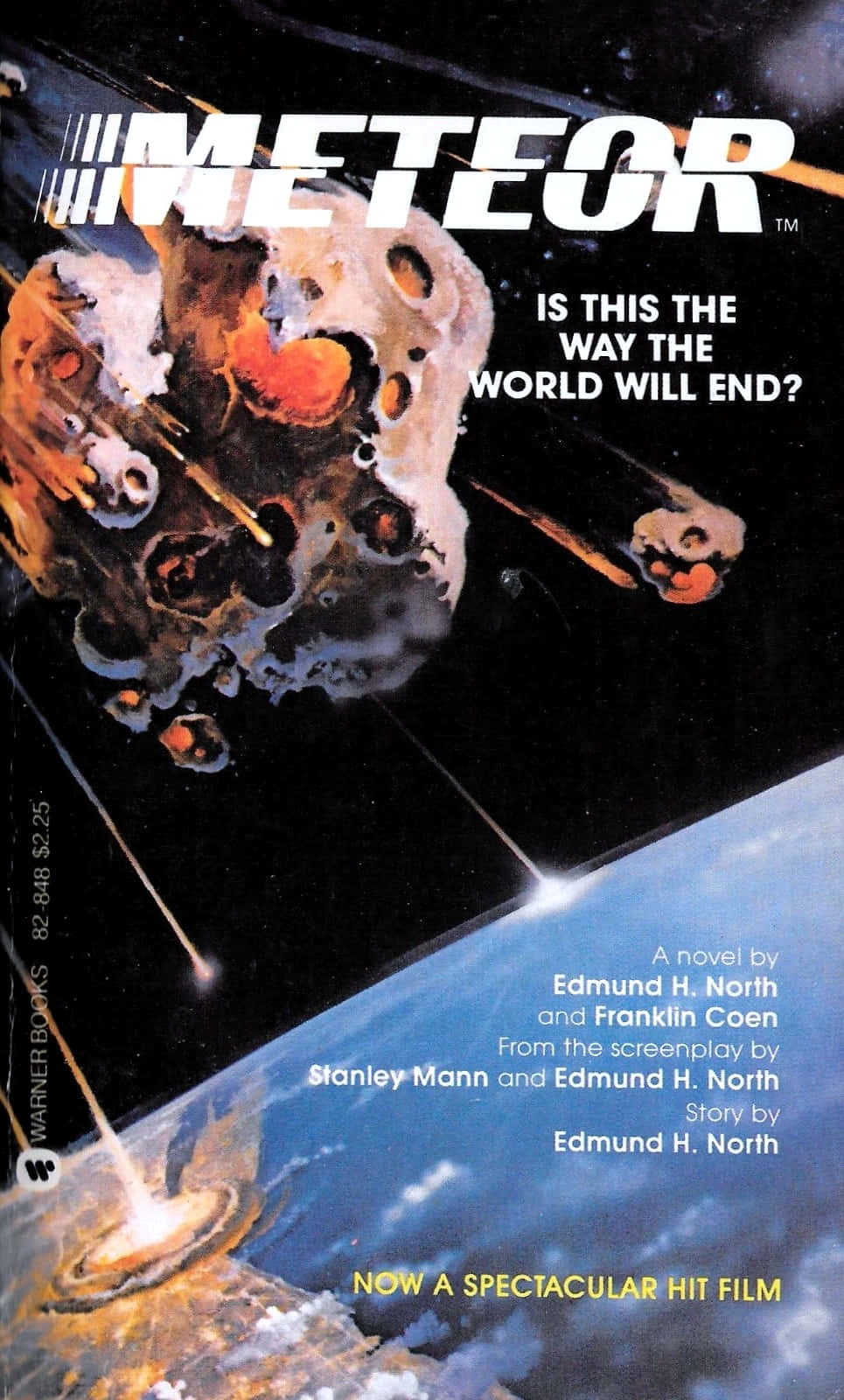
METEOR (1979) Novelization


Based on the 1979 film written by Edmund H. North and Stanley Mann. Directed by Ronald Neame. It starred Sean Connery, Natalie Wood, Karl Malden, Brian Keith, Martin Landau, Trevor Howard, Richard Dysart and Henry Fonda. The book is credited to Edmund H. North and Franklin Coen. I have a draft of the screenplay dated October 19, 1977 that is credited only to Stanley Mann.  I believe that this novelization is based on that draft.

METEOR was one of the last of the disaster films made in the 1970's and while the film itself is disappointing it nevertheless has a lot of positives. From a story standpoint, the film tells its story grounded in realism and avoids melodrama—this is more DEEP IMPACT than ARMAGEDDON. The emphasis is on character. There is spectacle but plot-wise it is organically handled. In many ways the film should have been an outstanding example of the genre, differentiating itself from things like THE TOWERING INFERNO and EARTHQUAKE and falling closer to ON THE BEACH.

Alas, the film is ultimately a miss. Too often the film presents us with details that take you out of the story. Some of the details are scientific—early in the film a conversation is shown between Earth and a manned spacecraft in the vicinity of Mars. The conversation is shown as being real-time whereas in reality there would be a considerable lag (6 to 22 minutes depending on where the craft was) between the two sides. Am I picking nits? Perhaps, but the filmmakers talked about scientific accuracy in the press so I think it's a fair point. Additionally, there are moments in the film where views from outer space are shown on video monitors with no explanation as to how they are being produced. Are both quibbles a result of narrative shorthand? Sure, but again, they went on about how accurate it was in the press. . .

And I guess WAS accurate. . .for a 1970's disaster film that is.

The above is minor, and I could have happily lived with it if not for the film's major failing—the special effects. For whatever reason, they were not able to get anyone to handle the visual effects competently. Just about every shot of the titular meteor is a bad optical and every shot of the orbit-based missiles are bad miniatures. The scenes of destruction are usually the raison d'être for a disaster film, and these are just as badly handled. There is a scene of an avalanche in the alps that reuses footage from the 1978 low budget film AVALANCHE.

What's astonishing is that the filmmakers delayed the release of the film in order to have the visual effects redone. This decision was made after filming was complete and, reportedly, after the film was "done". The original effects team was fired; a new team came in who also struggled to deliver the effects. Very late in the day yet another team was brought in. Considering how poor the effects that made the film are, it makes you wonder how bad the original effects were.

This is a shame. Money was obviously spent on the film. The cast is good, the story is inherently dramatic. If the effects were at least decent it would be a lot easier to take.

The novelization corrects all of the flaws of the finished film. Characters are more fleshed out (Sean Connery's character is a professor at Columbia, for instance), the science is more realistic, one is not constantly taken out of the story by obvious model work. There is more political shenanigans (wisely left out of the film but not unwelcome here), and the Connery and Wood's character have a full blown lover affair. It's all well-handled and is the ideal version of the story.

Sunday, September 21, 2025

Kelly's Heroes (1970) Novelization


KELLY'S HEROES
By Burt Hirschfield
Based on the screenplay by Troy Kennedy-Martin
1970

In World War II, during the period following the breakout at St. Lo and the Liberation of Paris, the Third U.S. Anny made its fighting dash to Germany's Rhine River. In the vanguard of the Third Army were numerous reconnaissance companies. These Armored Cavalry units moved with the situation, probing, fighting and developing contact with the enemy far beyond the main body. Their tactics were as unpredictable as the front, which was, to say the least, fluid. Such a company---and its equally unpredictable personnel---is the subject of this story; a story of a somewhat questionable mission that aimed to deny to the German Army a huge treasure trove of more bombs and bullets, and at the same time to provide aid, comfort, and a large slice of wealth to a group of wild, enterprising G.I.'s.

The Warriors ... Kelly's Warriors ...

***

When KELLY's HEROES was released by MGM in 1970, it was not quite the film that the filmmakers intended. The original screenplay was a big sprawling story that was decidedly anti-war. However, after filming, the story was altered to both reduce the running time and to homogenize the final product. A hippy-dippy pop tune was imposed over the bulk of the main titles, for instance. The song helped make the film more of a straight "war comedy" instead of what it was intended to be—a thoughtful, anti-war message film (with action). It was also a cheap ploy to make as much money as possible from the film. MGM was in poor financial shape at the time and was desperate to release something that would bring money in.

The producer removed over twenty minutes of material to bring the running time down. It was at this point that the film was retitled to KELLY'S HEROES. It was known as THE WARRIORS during filming, and then briefly as KELLY'S WARRIORS.

This novelization is based on the original screenplay, which includes elements cut before filming, as well as the producer's trims. Because it is based on the original script, this novelization retains the anti-war elements. They are not overt or preachy, but rather presented organically—these are battered men who have lost faith in what they are doing. The novelization includes the backstory that fleshes out how lost the men are. The movie is decent, but I think I enjoyed reading this more.

It also includes whole scenes and characters that don't exist in the final film.  One example: 

The team encounters a mother and daughter while en route to the town with the gold. The daughter becomes a love interest for the Clint Eastwood character. I don't believe these scenes were ever filmed. Ingrid Pitt was apparently cast as one of these characters and she has said in interviews that her role was eliminated right before shooting started.

I found this description of scenes that were apparently filmed and cut here (based on the Cinema Retro "Special Edition" on the film):

  • First scene cut: "Oddball and his unit pack up camp and the local village girls are running around half naked." (Photos of the sequences were used in the film's publicity.)
  • Two sequences of Kelly and his men in the barn, waiting for Oddball's unit:
  • A conversation between Kelly and Big Joe (wherein we learn why Kelly was made the scapegoat for the attack that resulted in his demotion)
  • The platoon decides they don't want to continue with the mission; Gutkowski threatens Kelly at gunpoint, but Big Joe and Crapgame side with Kelly and everything turns out A-OK
  • The platoon encounters a group of German soldiers and naked girls swimming in a pool (John Landis remembered this scene)(filmed at Kaminca Park on the banks of the River Danube, in Novi Sad)
  • "During the attack on the town, production designer Jon Barry had a cameo as a British airman hiding from the Germans, and there was a scene with Kelly, Oddball and Big Joe discussing tactics while standing on an abandoned Tiger tank."
  • When Kelly and co. drive off at the end, a bunch of soldiers (including John Landis) shout at them that they are headed in the wrong direction.

Excerpt:

Kelly considered Oddball without enthusiasm. Oddball held the glance for as long as he could, then looked away. He indicated the exit. For the first time, Kelly became aware of music playing somewhere outside. He started for the doorway, looked back. The girl had come around in front of the files. She was naked and perfect. Kelly wet his mouth.

"You like that?" Oddball said hopefully.

"Just thinking back," Kelly said.

"And?" Crapgame said.

"And I remembered," Kelly answered, heading for the stairs. "Every last detail."

Outside, in the glare of the sun, Kelly allowed a moment or two for his eyes to adjust. Then he saw the dancers, three men stripped to the waist, dancing Greek-style. Like Oddball, Iron Crosses dangled from around their necks. They moved in an ever-narrowing circle around a young girl who sat cross-legged on the ground, a euphoric expression on her lovely young face. In her hand she held a bayonet and there was a steel helmet on her head. Otherwise, she was naked.

Beyond the dancers, were the rest of Oddball's crew. In various stages of dress and undress, the men lay with naked girls on the grass eating grapes and drinking some of the local wine from a barrel, which was perched strategically on one of the Sherman tanks. The girls, Kelly noticed with interest, were very young, very pretty, very healthy.

A few men were busy dismantling the gleaming high-explosive shells used by the Sherman's guns with absolute unconcern for the danger involved. Kelly watched one man as he emptied one of the capsules, then filled it with a quantity of very bright paint.

Kelly looked back at Oddball. He shrugged, mouth turned in that deceptive smile. "These are the boys," he murmured.

"And those are the tanks," Kelly added, his disapproval evident.

Oddball's eyes flickered to the crusted, scabrous lumps of armor that seemed too dirty and rusted to move. "Yeah." He nodded wisely. "You are noting the dirt and the rust? We like to give the impression that we just come out of action and are in need of a period of rest and reorganization. 'That way nobody bothers us."

Oddball moved forward, past the naked girls and their friends, leaped onto the first tank and struggled to open the two rusted hatch covers. At last he succeeded and a flash of sunlight glittered off the gleaming chrome and silvered surfaces of the engines. Kelly wanted to see for himself. Thirty cylinders of the five Chrysler motors sat pristinely on their beds, polished and modified as if they were on display in the showroom of a dealer.

"I'm impressed," Kelly said.

"Notice, please," Oddball said, "that the machinery is in good working order. It has in fact been improved on by our mechanical genius, here---Moriarty. A man with the muffin face and the loose gait of a punch-drunk fighter joined them, grinning, head bobbing loosely. "Yeah," he said. "Yeah, yeah."

Saturday, September 20, 2025

The Curious case of The Dark (1978) Novelization


Written by Max Franklin (aka Richard Deming). Based on the 1979 film written by Stanford Whitmore and directed by John 'Bud' Cardos. It starred William Devane, Cathy Lee Crosby, Richard Jaeckel and Keenan Wynn.

This is an odd one. The behind-the-scenes story of this film is definitely more interesting than the film itself. The film began with Tobe Hooper directing. However, Hooper was fired after only a few days, with journeyman director John 'Bud' Cardos taking over. Cardos is not a stylist and did what he was hired to do: finish the film on time, whatever it took. 

Where it becomes interesting is that the filmmakers decided to alter the story after filming was completed to inject a science fiction aspect into the story. Namely, they made the monster an alien that can shoot lasers from his eyes. Exactly what the original story was is...complicated.

There are reports that the story at that point was about an autistic person who had been locked away for most of their life, going on a murder spree when they are freed by a house fire. This info seems to originate with an interview with Cardos that was in the May 1984 issue of Cinefantasique. This was later repeated in the commentary that Cardos participated in for the 2017 Code Red Blu-Ray release.  


Which brings us to this novelization. The only screenwriter ever credited on The Dark was Stanford Whitmore. The novelization claims to be based on his screenplay, but it is NOT about an autistic person killing people. It tells the story of a 100-year-old Zombie that cuts off the heads of his victims with a scimitar and then eats them. The father of the first victim and a newscaster band together to investigate what is going on. In all ways, the novelization reads like an episode of the Night Stalker TV series, without Carl Kolchak. This is not a bad thing.  A still in the photo section includes a scene of a death BEFORE the alien was added, strengthening the case that the alien was a very late addition.

Let's try to unpack this. The final film matches the zombie plot mentioned above, save for the lasers. The characters all talk about the monster being a zombie, and never reference that the victims have been "blown up" by lasers. The monster, when finally shown, is wearing contemporary clothes and does not really match the description of the zombie in the book.  The autistic angle of the plot bears some similarity to Hooper's later THE FUNHOUSE, so perhaps he made that film to get the idea out of his head.

The changes were talked about in issue 12 of Starburst Magazine: 

"Okay, so it was a gamble," admits Larry [Fredericks], the Cinema Shares president. "But after doing our market research...we decided to shift the emphasis from conventional horror to a sci-fi image, which the plot allowed us to do. We re-thought the publicity campaign completely and really put some hours into getting the new art just right. With our experience of selling across the whole range of world markets, we figured we could make the film really work." 

Note, nowhere in the above is the idea of making the film better mentioned. I think the changes were made because the filmmakers had a film that wasn't very good. According to producer Igo Kantor in the above-mentioned 2017 Blu-ray commentary, the switch to the alien occurred after filming was complete. So switching to an alien was a last-ditch effort to salvage the investment when it became clear the film wasn't very good. 

Watching the film objectively, I think about a minute of alterations were done to support the alien plot-change:

  • A prologue that explains that the alien came from the stars was added.
  • The scenes of carnage stop before the zombie does anything, with lasers and explosions being overlaid on top of the original footage.
  • Some insert shots showing the monster's hands as claw-like and decidedly non-human.
  • The climax, which involves the alien battling a slew of police officers, appears to have some new footage to better support the laser angle.  Some full face shots of the alien shooting lasers, some pyrotechnic effects showing the effects of the laser hits.

That's it. I don't see anything else that was added. Of course, based on the novelization, we can see that things were removed or changed. But it is clear, at least to me, that the book used the same screenplay for the film that was shot, at least in part. Most of the names are the same, and the basic plot follows the same beats.  The fact that the monster is wearing regular clothes in the film makes me lean toward the autistic person as explaining the monster (inasmuch as that really explains how he could take so many gunshots and still be alive) . I think the film had a rushed filming schedule that resulted in something that has a couple of good scare scenes but not much coherence.  The producers tried to jazz it up with lasers to try to get their money back. 

So where did the story in the novelization come from?  Given that the filmmakers have repeatedly stated that the monster was an autistic person, I have to conclude that either the author worked from an earlier script that was ultimately changed to what Cardos described, or he took it upon himself to improve things with a story of his own. Cardos came on board about a week into filming, so perhaps there was an earlier script without the autistic person. This could have been what was provided to the author of the book.  I am not sure we will ever know for sure. 

Which is all too bad because this is a good novelization! The author really spends time with things and makes it a satisfying read. Considering that the basic plot does not make complete sense (what is the significance of the blind guy, anyway?), the author does a very good job of trying to make it clear.  If nothing else, the book describes a movie I'd much rather watch than the actual film made.

Excerpt:

At five-thirty in the afternoon Randy Morse had just finished making love to his latest conquest for the sixth time that day. She was a lovely Eurasian girl of eighteen named Camille Quam, whom he had met at an actors' workshop a week before. Since then they had been out of each other's sight for only brief periods, even making the rounds of TV studios to read the call-boards together. A good deal of the time, both day and night, they spent in bed together, always at his apartment, because she still lived with her parents. 

Sitting up in bed, naked, Camille leaned over the side of the bed to reach into her purse on the floor. She drew out a marijuana cigarette, a marijuana clip, and a packet of matches. Lighting the joint, she took a deep drag, held it, and passed the joint over to Randy, using the clip. 

Exhaling, she said, "Get it on, lover." 

Randy took a drag and handed back the clip. The phone on a bedside stand rang. Exhaling, he lifted the phone. 

"Hello," he said. 

"Randy?" a mature female voice said. 

"Oh, hi, Marge." 

"Busy tonight?" Marge Madison asked seductively. 

He glanced at Camille. "Why?" he asked. 

"His nibs flew to New York this morning. He's flying back again late tonight, but meantime, I thought perhaps we could discuss that part." 

"Sure," he said instantly. "I'm free."