Showing posts with label Private Detective. Show all posts

Sunday, July 5, 2026

Hickey & Boggs (1972) Novelization


Written by Philip Rock
1972 Popular Library paperback edition.

Based on the 1972 film HICKEY & BOGGS, written by Walter Hill and directed by Robert Culp. It starred Robert Culp, Bill Cosby as the titular heroes.  The film also boasts a pretty impressive cast of people who had not yet achieved stardom (or at least steady work)--Michael Moriarty, Ed Lauter, Vincent Gardenia, James Woods, Jack Colvin and Rosalind Cash. Also included are Robert Mandan and Bill Hickman, who appeared in a number of films around this time more or less playing the same type of character.

This film was largely unavailable in the US on home video until its 2011 DVD release.  Up until that time, you had to try to catch it when it was broadcast on TV.  I've had the book since 1980 or so, and having read it multiple times over the years, when I finally saw the movie I was surprised how different it was from the book.  It tells the same story, but while the film was rated PG the book (and original screenplay I presume) is R-rated, full of graphic violence, adult language, and multiple instances of naked people.  The movie, which was partly trying to cash in on Culp's and Cosby's I SPY success toned all of that way down.  I was disappointed when I first saw the movie, but having watched it a few more times, I can appreciate the differences.  

The book tells a depressing story about people who have largely given up on life in a fairly realistic way.  The film is probably more depressing and makes Culp's character, in particular, seem more of a mess.  The film comes across as a new wave detective story for the 70's, much in the same way that Altman's THE LONG GOODBYE (1973) did.  Altman's film is a lot more artistic than the lower-budget HICKEY & BOGGS could manage.  It has its moments, but too often there are production touches that are barely above the TV-movie level--blood is obviously bright red paint, and lighting is sometimes too flat.  Still, the film is not at all a disaster and is well worth seeking out.  Culp the director is more interested in feel, so a lot of the backstory was omitted from the film.

The book is even more depressing since it tells a more complete, tougher story.  

Excerpt:

Albert Hickey parked his battered Nova in the lot behind Musso and Frank and walked over to Las Palmas and then down to the boulevard. The August heat hammered him into the pavement. He stood well over six feet but he felt like a midget by the time he reached the corner; a fat, wet midget in a chocolate-colored suit. He stood in the meager shade of a shoe store's awning and lit a cigarette. He wanted to go across the street, across the shimmering asphalt to the other side of Hollywood Boulevard, but it seemed such a long way for a melting midget to manage.

"You got any change, mister?"

The voice came from miles away. It floated up to him, thin as heat waves on the freeway.

"What?"

"Change. . . you know."

He stared down at the girl. It was a relief to see her, not that she was worth looking at. She was pale-faced and lank-haired. A strung-out blonde in granny-style patched blue jeans. Her feet were bare and the color of the sidewalk, only dirtier. She was ginning at him, her teeth translucent, like half-cooked rice. No, not much to see, but he was looking down at her. He hadn't shrunk, after all.

"I don't have any. I spent my last quarter on a yacht."

She sneered at him the way a wolf might sneer if you offered it a grapefruit.

"Fuck it. I should have known better."

She ambled along the street toward Cherokee. There was nothing ahead of her but a lot of hot pavement and a group of pale young men handing out slips of paper that foretold the end of the world. He almost felt sorry for her. Almost, but not quite.

All right, he thought, get on with it; it's only across the street All you have to do is put one foot ahead of the other and wing it from there.

Monday, December 21, 2020

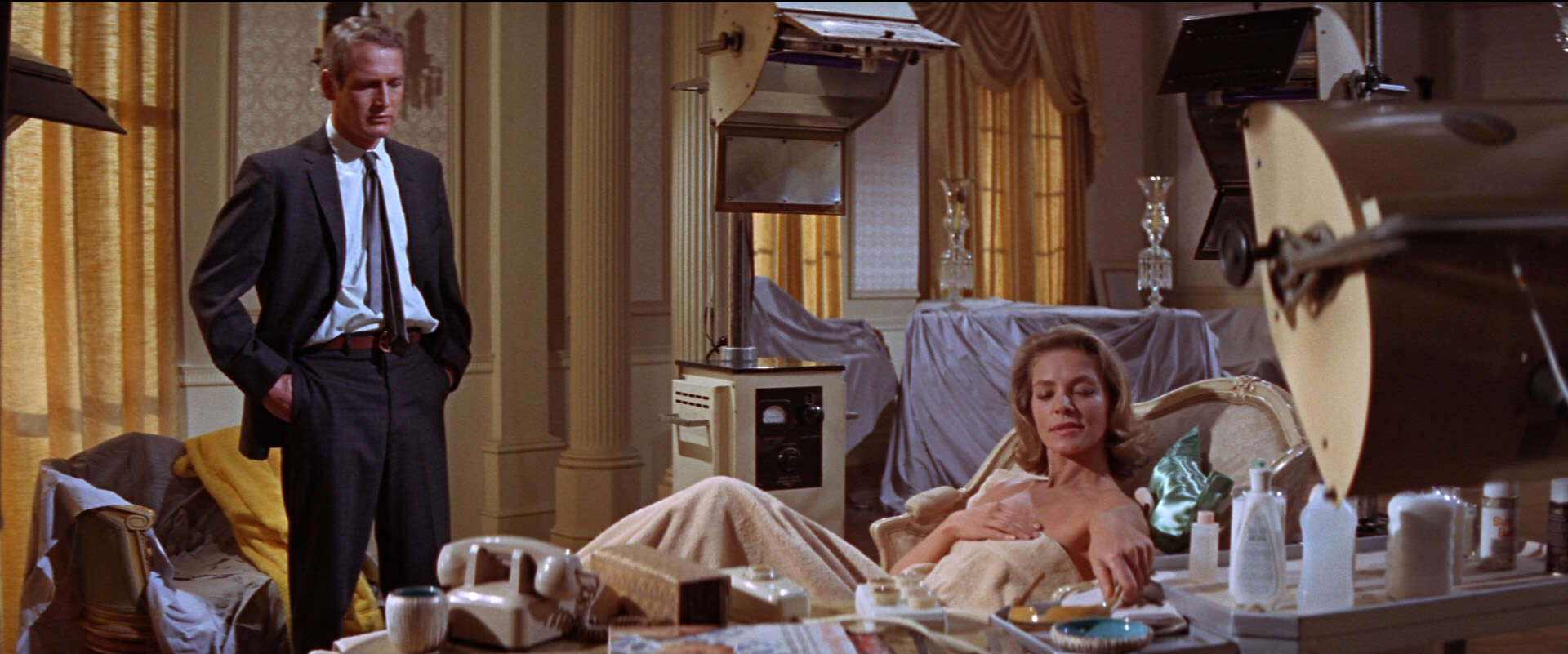
HARPER

Directed by Jack Smight.  Written by William Goldman.  Stars Paul Newman, Lauren Bacall, Julie Harris, Arthur Hill, Janet Leigh, Robert Wagner, Shelley Winters, Strother Martin.  
1966, 121 minutes, Color, Not Rated.


HARPER is based on the first of the Lew Archer" series of books by Ross MacDonald.  The film version had a screenplay written by William Goldman, who had written only one movie prior to this but had written several books.  He later credited this film as being the one where the lightbulb went off in his head about screenwriting, and that he would be successful at it.  He was, in fact, very successful at it and would later write such films as BUTCH CASSIDY AND THE SUNDANCE KID (1969), PAPILLON (1973), THE GREAT WALDO PEPPER (1975), MARATHON MAN (1976), ALL THE PRESIDENT'S MEN (1976), THE PRINCESS BRIDE (1987), MISERY, and MAVERICK.  He was also gainfully employed as a script doctor.


The film is remarkably faithful to the book, but it has been judiciously edited to be more streamlined.  In this way, Goldman proves that he understands movie plotting, innately (apparently) understanding what can be glossed over and what needs to be shown in detail.  The plot involves a missing husband.  Newman plays Lew Harper (changed to Lew Archer for some reason), a private detective hired by Albert Graves, the lawyer of the man who's gone missing.  Harper is a bit of a sad sack, but as we ultimately see is pretty good at his job.

The film is stylishly made but almost undone by its desire to be topical--it wallows in the Hollywood vision of the hip and swinging 1960's and this ultimately dates it badly; Go-Go dancing is featured entirely too much for this to be a timeless entertainment.  By contrast, the novel is not nearly as locked in time even though it was originally published in 1949 and is awash in all kinds of post-war ennui.  Graves and Archer/Harper are not quite close enough in age for their friendship to make sense in the film, but the novel clarifies that they served together in the war, which feels right. 

Aside from Newman, the cast is full of lead actors of a somewhat faded luster, as well as some competent character actors.  Lauren Bacall, Shelley Winters and Janet Leigh do the best with their roles, but Robert Wagner and Strother Martin also score in secondary roles.  Casting less old-school Hollywood faces may not have helped the film, but I can't really say anyone is bad in it.

Newman was active in the 1960's--HARPER is one of seven films he appeared in that were released from 1966-1969.  All of these films are interesting roles for Newman, with the standouts being HOMBRE and COOL HAND LUKE (both 1967).   He is interesting even in the misfire films, like TORN CURTAIN (1966).  Newman was uncommonly subtle in his craft by this point in his career which no doubt cost him some acting awards, but his work was way above average.  A method actor, much of his work is internal, and was not helped by his preference for playing strong silent types whose actions ultimately tell the audience what kind of person his character really is.  


In HARPER he keeps everything close to his vest until the very end of the story.  Newman is quite good in the role, bringing a lot of reality to the proceedings.  He is consistently behind the curve plot-wise so the majority of what he does is reactive, but that is exactly his strength.   He plays the sad sack well--so much so that the majority of the people he interacts with consistently underestimate him.  When the time comes, Harper brings the goods in much the same way that Eliot Gould's Philip Marlowe does in Robert Altman's THE LONG GOODBYE (1973).

While Newman would return to the role nine years later in THE DROWNING POOL (1975), his work in this film should have been the start of more than it was.  As it turned out, this film wasn't the hit everyone wanted.  He would score with COOL HAND LUKE (1967) the following year, but big box office success would not come until BUTCH CASSIDY.


Still, the plot is intelligent, the characters are interesting, and the mystery well handled.  Jack Smight directs with style and the widescreen cinematography by Conrad Hall is fabulous. I especially like how Smight uses long tracking shots in the film.

Warner Archive released an outstanding Blu-Ray of this a few years back.  It features a commentary by William Goldman that originally appeared on the DVD.