Monday, May 3, 2021

Silent Madness 3-D

Silent Madness 3D
Directed by Simon Nuchtern.  Written by Bob Zimmerman & Bill Milling.  Additional Dialogue by Nelson DeMille.  Stars Belinda Montgomery, Viveca Lindfors, Solly Marx.  
1984, 93 minutes, Color, Rated R. 


Summary:
When a glitch in the computer system at an asylum for the criminally insane results in the release of the wrong patient - a giant-in-stature homicidal maniac named Howard Johns, who has a penchant for killing college coeds - it’s up to one of the institute’s top doctors to track him down. Unfortunately, it’s not just Howard she has to worry about, as the administration of the asylum has decided to cover up the error to avoid bad press, going as far as to hire a duo of thugs to permanently ’silence’ the good doctor. Soon enough, Howard finds his way back to the sorority house he once terrorized and sets out to murder the latest batch of nubile coeds who have taken up residence in the stately manor.

3D Rating:  **** out of *****

What makes a good 3-D film?  One could argue that the same rules that apply to 2-D films should apply to 3-D.  Good is good, right?  But that is not the case.  Any movie can be better in 3-D.   I'm not talking novelty--I mean the very nature of it's dimensionality can enhance a dramatic work in unexpected ways. This is where "real" 3-D sets itself apart from "converted" 3-D.  Real meaning either two cameras or lenses captured the spatial information real-time on a set.  Converted meaning a 2-D image was processed to artificially create the two images used to make the 3-D image.

In a converted film, the visual effects technician has to manually determine what the dimensionality will entail, and how nuanced it will be.  This is not unlike what a cameraman using a 3-D rig would do on set, but the difference is every shot converted to 3-D costs money, and by and large only a certain amount of money will be spent on something as innocuous as someone walking down a corridor to get from point A to point B.  Certainly, some fine conversions are out there, but even in the best conversion there will be aspects that don't take full advantage of the third dimension.  And the reasons for that can be varied but it usually comes down to either money, or the filmmakers playing down the dimensional effects because they do not want "gimmicky" 3-D.

However, when you talk about a "real" 3-D film all of that depth and real world spatial orientation is just THERE.  True, the camera system used was adjusted to affect depth, but by and large when real 3-D is both filmed and presented correctly it's an amazing experience.  One of my film truisms is that a great presentation will always make marginal entertainment more watchable.  

Which brings us to SILENT MADNESS.

Now, this is not a great film.  I had never heard of this before seeing it for sale on Black Friday 2020, and only bought it largely due to it being released by Vinegar Syndrome and featured 3-D restoration work by the 3-D Film Archive. There would be a vigorous discussion about whether to call it a "good" film.  The acting is variable, and the story is pretty dumb, but even in 2-D it achieves some suspense and atmosphere.  

However, it is fabulous 3-D entertainment.    Truly, this is one of best 3D experiences I have had in many years.


3D disclaimer:  I have a LED TV that can display digital 3D.  My 3D reviews are based on how things look on my set. I am aware that other methods of displaying 3D may be different.

SILENT MADNESS was filmed in Arrivision 3-D, which was a single camera system that used a special lens to capture both right eye and left eye information on a single strip of 35mm.  Because only half of the 35mm frame was used, films shot in Arrivision 3-D are typically more grainy than not.  The director of photography was Gerald Feil, who had previously filmed FRIDAY THE 13th 3-D (1982).  Judging by the results on display in SILENT MADNESS he learned a few things from that experience.  


SILENT MADNESS does not have a great story.  According to the supplemental features on the disk, the film started as one kind of film but ultimately morphed into a slasher film.  As such, the film is a little clunky, characterizations are a bit thin, and the acting is a bit variable.  The film does tell a (generally) coherent story and generates suspense, so it satisfies as early 1980's horror film even without the third dimension.  

When viewed in 3-D, however, the film is an absolutely hoot.  Real care was taken to highlight the dimensionality of the different locations, and there are numerous "pop out" effects.  Additionally, the final chase sequence adopts a filmic style with colored gels that is quite different from what preceded it.  Think Mario Bava as opposed to FRIDAY THE 13TH and you get an idea of what I mean.


The Blu-ray is taken from a release print, as the original negative appears to be missing.  The print used for this release is not great.  Many of the same faults found in the other Arrivision 3-D films JAWS 3-D and FRIDAY THE 13TH 3-D are also present here--alignment issues and a general all around softness.  These faults are largely baked into the print used, so while The 3-D Archive has done a remarkable job making it look as good as it does here, there was also only so much that could be done.

Also included on the disc is a "sizzle reel" which is in better condition than main feature.  This sizzle reel includes footage not in the final film and also presents a black and white flashback sequence in full color.  It's an interesting extra.  Colors are stronger as well, which suggests that a scene in an experimental hospital wing was influenced by the body farm in COMA (1978).

Also notable is that the release includes two 3-D versions of the film.  There is the digital 3-D version, of course, but there is also an anaglyph version.  I wasn't interested in this when I bought it, but I have to admit it works far better than I expected.  My experience with anaglyph 3-D was limited to broadcast "special events" when I was growing up, which typically did not work very well due to inherent limitations of NTSC.  However, the good folks at the 3-D Film Archive have developed a proprietary anaglyph process that works really well.  Watching it in anaglyph is a very viable alternative if you are not equipped for digital 3-D.  I've included some screenshot examples of anaglyph from the sizzle reel.  If you have the appropriate glasses, the 3-D should work well on your computer monitor.  

Vinegar Syndrome also includes at least one pair of anaglyph glasses and an embossed slip cover.

The Magnificent Ambersons

THE MAGNIFICENT AMBERSONS
Directed by Orson Welles.  Written by Orson Welles.  Stars Tim Holt, Joseph Cotten, Dolores Costello, Anne Baxter, Agnes Moorehead, Ray Collins.  
1942, 88 minutes, Black And White, Not Rated. 


Where to start with this one?  

Rightly or wrongly, the original version of THE MAGNIFICENT AMBERSONS stands as one of the great lost films in the history of Hollywood. This was Orson Welles' second film for RKO, after CITIZEN KANE.  The controversy generated by KANE did not translate into box office dollars, so when the first cut of AMBERSONS tested poorly, RKO instructed the film's editor to shorten it dramatically and reshoot some of the more extreme scenes to be more palatable.  The editor was Robert Wise.  

Welles was out of the country while most of this unfolded, and it's intriguing to consider what might have happened had he been in the country.  Evidence suggests that he was not opposed to making changes, and memos exist where he suggests even more drastic restructuring than what ended up in the released film.  The story of why he was out of the country is an interesting story in itself--he was appointed a goodwill ambassador to Latin America by the Government and so started to make an anthology film of life in the lower Americas.  Although jointly funded by the U.S. Government, RKO pulled the plug based on the footage being sent back, which was also most likely as an indication of how far Welles' star had fallen.

While most can acknowledge the innovations of CITIZEN KANE, even if they don't care for the film itself, it's not generally understood that AMBERSONS was just as innovative in its own ways as his previous film. The film's visual look is what most people gravitate to, but there are other, more subtle innovations that were lost in the editing. Specifically, the original version of AMBERSONS featured multiple scenes of extremely long takes with intricate camera moves and/or subtle character interactions.  This is not to suggest that Welles was being theatrical in the way of stage plays, but rather theatrical in the medium of film*.  The shot length for many of these scenes originally were far outside the shot length norms of 1940's Hollywood. The film is also much darker—literally and figuratively—than typical films of the era, with deep shadows that mirror the characters emotions. 

Then there are the sets. Going against convention, Welles had the Amberson manor constructed as a contiguous multi-story set. The detail lavished on the set was impressive (and expensive) and contributes enormously to the believability of the setting. It also allows for some highly expressive (“arty”) shots that use both depth and shadows to outstanding effect.


While Welles does not act on screen in AMBERSONS (the only time he was ever able to do that for one of his films) he contributes the narration. The first few minutes of AMBERSONS are an absolute joy to behold, mainly due to his rich baritone voice.  It is also worth noting that the first half hour of the film is the least molested of what remains.  There are deletions, but no new scenes.

100% of the long takes mentioned above were compromised by the pre-release editing done to "improve" the film. The two biggest areas that were harmed were the ball sequence--a long single take that wound from one end of the set and back again, all while dialogue scenes and dancing took place. Welles claimed it was an entire reel of film, but even if it wasn’t, it was still a tour de force. Since most of the edits occurred after the halfway point, much of the scene still remains in the film, as it is relatively early in the story. Not so lucky was the original ending, with Agnes Moorehead's emotional explosion chopped off before it really gets going.  Likewise, the cut-in-half kitchen scene explains that some of the Amberson land had been sold because they needed the money.  In fact, just about all of the scenes that illustrated how society was changing, for better or worse, and how it affected the family, were lost in the re-editing.


I think that if the original 131 minutes version had been released in 1941 it would have died a death at the box office, so it's reasonable that RKO would have tried to "fix" the film. The question of whether the film was taken out of Welles's hands is more complicated.  Superficially, this became the first in many films in which Welles lost control. Looking at it a little more closely, however, it's an open question whether Welles was removed or whether he removed himself.  He left for South America to film his Latin American project before AMBERSONS was fully edited, and one has to wonder why. Was he simply naïve, or was he aware that the film was problematic?  Perhaps he didn’t have the stomach for the compromise needed to appease the studio.  Sheer irresponsibility also cannot be discounted.

Based on what is known about the original version — the continuity script for that version exists  —it was an artistic triumph but not an "easy" film.  The film is also aggressively "arty" and that may have also been a problem with audiences outside of the bigger cities. Lastly, it was emphatically not a "feel-good" movie at a time when the United States was adjusting to life in wartime.  All of these factors would have impacted its chances at the box office.  Aside from the above, the film was flawed by having one of the most unlikable lead characters in film history. I happen to think that Tim Holt is fine in the role, and played it exactly as Welles wanted, but the character is a cad of the highest order and it colors much of the story. 

The fact that the film's portrayal is a faithful rendering of the character from the Pulitzer Prize-winning novel does not really help matters — what works in print sometimes just doesn't work on screen.  If Welles had played the lead, he might have made the lead character more likable.  This may have improved its chances at the box office. Maybe.  

That said, I also 100% believe that if the long version had been released it would be considered a filmmaking masterpiece, right alongside KANE.  It probably would have taken a generation for it to outlive its box-office failure, but, like it or not, art generally prevails.  This is just my opinion, of course.

* On a side note, I personally have always viewed Mike Nichols' peak period (1966-1973-ish) to be "Wellsian" in nature as he approached things in a similar manner--long takes with a striking visual touch. 
**.  LADY FROM SHANGHAI (1948), MR ARKADIN (1955), TOUCH OF EVIL (1958).

Monday, February 8, 2021

The Nightmare Before Christmas 3D

Directed by Henry Selick.  Written by Caroline Thompson.  Story by Tim Burton.  Adaptation by Michael McDowell. Stars Danny Elfman, Catherine O'Hara, Chris Sarandon, William Hickey.  
1993, 86 minutes, Color, Rated PG.


Summary:
Bored with the same old scare-and-scream routine, Pumpkin King Jack Skellington longs to spread the joy of Christmas. But his merry mission puts Santa in jeopardy and creates a nightmare for good little boys and girls everywhere!.

3D Rating:  *** 1/2 out of *****

When THE NIGHTMARE BEFORE CHRISTMAS was released in 1993, Tim Burton was on a roll.   His first five films as a director were PEE WEE'S BIG ADVENTURE (1985), BATMAN (1989), EDWARD SCISSORHANDS (1990), BATMAN RETURNS (1992).  BATMAN (1982) was a huge hit, which no doubt enabled him to get NIGHTMARE BEFORE CHRISTMAS greenlit.  It was something of a dream project for him, and it took 3 years to complete all the stop-motion animation required to bring it to life.  This isn’t to say that Burton actively much worked on the film.  Director Henry Selick (JAMES AND THE GIANT PEACH) brought the film to life, overseeing all aspects of its creation.

It's a wonderful Halloween film*, full of witty visual jokes and real heart, perfectly realized by Director Henry Selick and his team of animators.  It was state of the art animation at the very tail end of the "traditional" visual effect era--JURASSIC park was ushering in the era of CGI at the same time.  The film contains an outstanding performance by Danny Elfman as Jack Skellington, and he also composed the songs and soundtrack.  The movie is great fun.  I had a CAV laserdisc set of this back in the day that I cherished.


3D disclaimer:  I have a LED TV that can display digital 3D.  My 3D reviews are based on how things look on my set. I am aware that other methods of displaying 3D may be different.

THE NIGHTMARE BEFORE CHRISTMAS was filmed in 2D and converted to 3D in post-production by ILM.  Needless to say, 3D was not a consideration during the making of the film, although the nature of how it was made--three dimensional animation--lends itself better than I expected to digital 3D.  


NIGHTMARE is full of crazy Expressionistic sets that lend themselves very well to 3D.   Additionally, the very nature of stop-motion animation takes the third dimension into account by its very design.  Pair that with the top notch conversion job and you end up with a very satisfying 3D experience.  All of the sets exhibit the type of dimensionality usually only found in true 3D films.  This means that every few moments there is something new to gawk at.  There are also some pop out effects that work much better than you would think.  This is an exceptional conversion that is faithful in spirit to the original production.  In this way it is like the Pixar conversions.

* This is not a Christmas film.

Sunday, January 3, 2021

The Finest Hours 3D

Directed by Craig Gillespie.  Written by Scott Silver, Paul Tamasy & Eric Johnson.  Stars Chris Pine, Casey Affleck, Ben Foster, Eric Bana, Holliday Grainger.  
2016, 117 minutes, Color, Rated PG-13.


Summary:
In February of 1952, one of the worst storms to ever hit the East Coast struck New England, damaging an oil tanker off the coast of Cape Cod and literally ripping it in half. On a small lifeboat faced with frigid temperatures and 70-foot high waves, four members of the Coast Guard set out to rescue more than 30 stranded sailors trapped aboard the rapidly-sinking vessel.

3D Rating:  ** 1/2 out of *****

At first glance, this seems like an odd choice for a 3D film.  More than half of it takes place at night, in poor lighting conditions and with weather further obscuring things.   The film is based on a true story and was originally intended as a smaller budget film.  It grew considerably in both scope and budget during production and ended up as a big-budget special effects bonanza.  Whether it needed a big budget to tell this story is debatable — it probably didn’t — but it ended up with over 1,000 visual effects shots.  

The core story is compelling, and the storytelling is intelligent, efficient, and respectful.  This respectfulness also results in a curious downplaying of the danger inherent to the events depicted.  Kind of like how a date can be too respectful if you are in the mood for some action--sometimes you just want something more and if your date is unwilling you can mistake it for a lack of interest.  I do not think that the filmmakers were uninterested in their audience.  I think it more likely that the original small film idea got swamped by the visual effects needed to make it more of an action film. 

All this said I liked the film.  Now, on to the 3D.


3D disclaimer:  I have a LED TV that can display digital 3D.  My 3D reviews are based on how things look on my set. I am aware that other methods of displaying 3D may be different.

THE FINEST HOURS was filmed in 2D and converted to 3D in post-production.  According to the director the filmmakers planned for 3D while making the film.  This is not always the case, so this attention to framing coupled with the significant amount of CGI layers results in a fairly robust 3D environment.  It does not hold a candle to a real 3D film, of course, but the conversion quality is above average.  

There are very little in the way of "pop-out" effects in the film, but depth is truly outstanding, which helps sell the different environments.  There is one shot that involves a verbal message being relayed from the top deck of the ship down to the engine room that is a good encapsulation of the benefits of the 3D in this film.  As each crew member relays the message, we see another hallway, stairwell, or open room that, subconsciously, reinforces the illusion that these characters are on an actual ship.  It's an impressive shot, made even more impressive since they were not on an actual ship and the shot in question was pieced together from multiple shots on the soundstage as a visual effect.  Any scene with weather also works effectively in 3D, which is most of the film.   


I won't say the 3D made this a dramatically different experience from the 2D version, but it's effective enough that it will be my go-to format if I watch the film again.  As stated above, this was an odd choice for 3D but it turned out to be a reasonably rewarding 3D experience.  It was not released on physical media in 3D in the United States as Disney had abandoned 3D by 2016. 


Monday, December 21, 2020

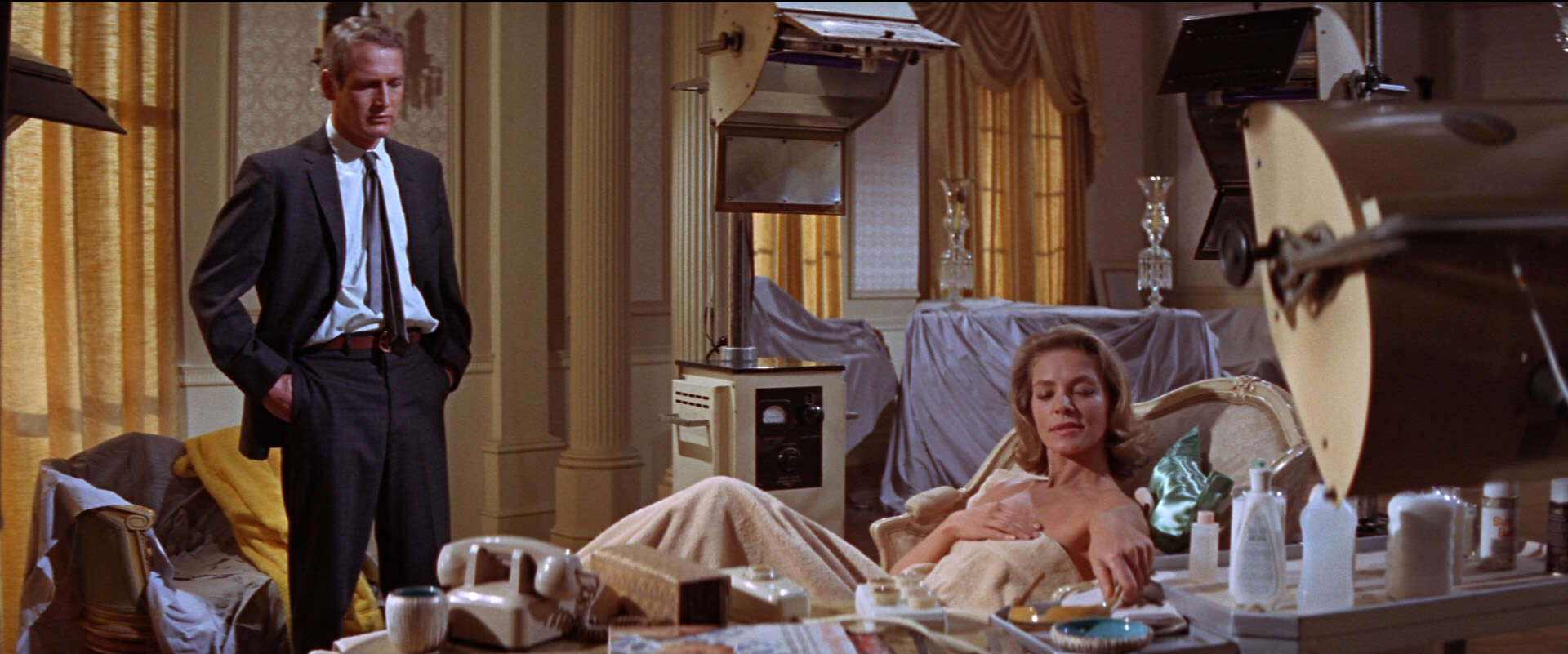
HARPER

Directed by Jack Smight.  Written by William Goldman.  Stars Paul Newman, Lauren Bacall, Julie Harris, Arthur Hill, Janet Leigh, Robert Wagner, Shelley Winters, Strother Martin.  
1966, 121 minutes, Color, Not Rated.


HARPER is based on the first of the Lew Archer" series of books by Ross MacDonald.  The film version had a screenplay written by William Goldman, who had written only one movie prior to this but had written several books.  He later credited this film as being the one where the lightbulb went off in his head about screenwriting, and that he would be successful at it.  He was, in fact, very successful at it and would later write such films as BUTCH CASSIDY AND THE SUNDANCE KID (1969), PAPILLON (1973), THE GREAT WALDO PEPPER (1975), MARATHON MAN (1976), ALL THE PRESIDENT'S MEN (1976), THE PRINCESS BRIDE (1987), MISERY, and MAVERICK.  He was also gainfully employed as a script doctor.


The film is remarkably faithful to the book, but it has been judiciously edited to be more streamlined.  In this way, Goldman proves that he understands movie plotting, innately (apparently) understanding what can be glossed over and what needs to be shown in detail.  The plot involves a missing husband.  Newman plays Lew Harper (changed to Lew Archer for some reason), a private detective hired by Albert Graves, the lawyer of the man who's gone missing.  Harper is a bit of a sad sack, but as we ultimately see is pretty good at his job.

The film is stylishly made but almost undone by its desire to be topical--it wallows in the Hollywood vision of the hip and swinging 1960's and this ultimately dates it badly; Go-Go dancing is featured entirely too much for this to be a timeless entertainment.  By contrast, the novel is not nearly as locked in time even though it was originally published in 1949 and is awash in all kinds of post-war ennui.  Graves and Archer/Harper are not quite close enough in age for their friendship to make sense in the film, but the novel clarifies that they served together in the war, which feels right. 

Aside from Newman, the cast is full of lead actors of a somewhat faded luster, as well as some competent character actors.  Lauren Bacall, Shelley Winters and Janet Leigh do the best with their roles, but Robert Wagner and Strother Martin also score in secondary roles.  Casting less old-school Hollywood faces may not have helped the film, but I can't really say anyone is bad in it.

Newman was active in the 1960's--HARPER is one of seven films he appeared in that were released from 1966-1969.  All of these films are interesting roles for Newman, with the standouts being HOMBRE and COOL HAND LUKE (both 1967).   He is interesting even in the misfire films, like TORN CURTAIN (1966).  Newman was uncommonly subtle in his craft by this point in his career which no doubt cost him some acting awards, but his work was way above average.  A method actor, much of his work is internal, and was not helped by his preference for playing strong silent types whose actions ultimately tell the audience what kind of person his character really is.  


In HARPER he keeps everything close to his vest until the very end of the story.  Newman is quite good in the role, bringing a lot of reality to the proceedings.  He is consistently behind the curve plot-wise so the majority of what he does is reactive, but that is exactly his strength.   He plays the sad sack well--so much so that the majority of the people he interacts with consistently underestimate him.  When the time comes, Harper brings the goods in much the same way that Eliot Gould's Philip Marlowe does in Robert Altman's THE LONG GOODBYE (1973).

While Newman would return to the role nine years later in THE DROWNING POOL (1975), his work in this film should have been the start of more than it was.  As it turned out, this film wasn't the hit everyone wanted.  He would score with COOL HAND LUKE (1967) the following year, but big box office success would not come until BUTCH CASSIDY.


Still, the plot is intelligent, the characters are interesting, and the mystery well handled.  Jack Smight directs with style and the widescreen cinematography by Conrad Hall is fabulous. I especially like how Smight uses long tracking shots in the film.

Warner Archive released an outstanding Blu-Ray of this a few years back.  It features a commentary by William Goldman that originally appeared on the DVD.


Monday, December 7, 2020

Young Adam

Written and Directed by David Mackenzie.  Stars Ewan McGregor, Tilda Swinton, Emily Mortimer, Peter Mullan.  
2003, 98 minutes, Color, Rated NC-17.


Summary:
Joe (Ewan McGregor), a rootless young drifter, finds work on a barge traveling between Glasgow and Edinburgh, owned by Les (Peter Mullan) and his wife Ella (Tilda Swinton). One afternoon they discover the corpse of a young woman floating in the water. Accident? Suicide? Murder? As the police investigate and the suspect is arrested, we discover that Joe knows more than he is letting on. Gradually we learn of Joe's past relationship with Cathy, the dead woman (Emily Mortimer). Meanwhile, an unspoken attraction develops between Joe and Ella, heightening the claustrophobic tensions in the confined space of the barge.

This is an interesting film, full of unhappy characters, death and what looks like some extremely chilly weather.  It's a mood piece, really, but notable for being intelligent and just ambiguous enough to require the viewer to pay attention.  Character interactions are realistic, the depicted way of life is hard, and there is very little joy in the film.  To say that it is unrelentingly bleak would be accurate but the film has much to offer in its darkness.  Life in the tiny barge is all about enforced intimacy and disillusionment. 


Based on a short 1957 novel by Alexander Trocchi, YOUNG ADAM unfolds in a manner that makes the central mystery difficult to anticipate.  This mirrors, in some ways, the way the book unfolds: it is written in the first person yet still conceals the mystery for an impressive amount of time.  Early in the film we see Joe on the barge from above as it passes by.  He is walking towards the back of the barge, and because the boat is moving forward, it appears as though he is walking in place.  This illusion perfectly mirrors Joe's life at this moment--he is a writer suffering from writer's block and has escaped from that by taking a job loading and unloading cargo on a small, barely solvent barge.  He is neither confronting his past nor trying to move forward.  He is merely keeping time until the next thing comes along.  Walking in place,, as it were. 


We learn that Joe had been seeing a woman named Cathy.  When his relationship with her reaches a crossroads, he takes the easy way out and walks away rather than committing to her.  Joe, as we learn, is somewhat selfish.   The only thing he takes with him is his typewriter, and he throws that into the river.  On the boat, when confronted with his desire of Ella, he ignores the consequences and goes after her.  When this drives away Les and leaves him with more responsibility than he wanted, he again takes the easy way out and walks away.  When he meets up with Cathy months later, and she tells him that she is pregnant, once again, he takes the easy way out and walks away.  When Cathy accidentally falls into the river, he does not jump in after her.  We had already seen him jump into the river to save Ella's son, so we know he has it in him.  One can surmise that there was no upside for him to go after Cathy.  He did not want a relationship with her.  When he jumped in to help Ella's son, it is quite likely he did so to earn her favor.


We never truly understand Joe perhaps, but the trick of the film is disguising his true nature for as long as it does.  There were certainly clues to his character. Joe literally has consensual sex with EVERY woman we meet in the film*.  However, he finds willing partners wherever he goes.  McGregor gives a good performance, remaining genuinely likable even after we learn he was there when Cathy died and kept it to himself, with tragic results.

For all of the above Joe is a troubling character.  If not for the genuine remorse he exhibits when Joe the plumber is arrested for killing Cathy--he knows how she died after all--one could make a case that Joe is a sociopath.  So, not a sociopath, just weak and selfish.


Tilda Swinton gives an impressive performance, infusing her character with a lifetime full of disappointment, and masterfully displays raw sexuality in a real and non-glamorous manner.   They say that when contempt enters a marriage, there is probably no way to recover from it.  Ella has contempt for Les, and it seeps out in their every interaction.   We learn that Les is impotent and unable to satisfy his wife sexually, and he proves to be equally impotent when faced with Joe taking his place in both Ella's bed and as the man of the barge.  

Emily Mortimer as Cathy should have received an award of some sort for a scene in which she is debased with food.   She is less clearly defined than the other characters.  Pretty, intelligent, and capable, she seems to be the idealized companion Joe thinks he wants.  However, in day-to-day life, he sees faults and can't help but be disappointed in her. 


At this point, it might be worth considering the meaning of the film's title.  There is no character named Adam in the story and apparently, Alexander Trocchi never explained what he meant by it.  It's possible he meant Adam in a biblical sense, and if the fruits of the Garden of Eden is a metaphor for sex, then Joe is a main character partaking of many apples.

The film remains in memory long after viewing.  

*Or does he? I admit I missed the possibility of an unreliable narrator the first few times watching the film, even though as the novel is told in the first person it is a shining example of the form.  I haven't re-watched the film since making this connection to see if it really changes anything.  It's just another potential layer of a truly remarkable film.

THE OMEN

Directed by Richard Donner.  Written by David Seltzer.
Starring Gregory Peck, Lee Remick, David Warner, Billie Whitelaw, Leo McKern
1976, 111 minutes, Color, Rated R, Panavision 2.35:1


SPOILERS BELOW- READ WITH CAUTION

A diplomat (Gregory Peck) discovers that his son was switched at birth with the spawn of Satan.  When one of the priests involved in the deception recants years later and tries to make amends by confessing his sins to the diplomat, the diplomat is initially skeptical.  When people start dying under mysterious circumstances he slowly comes around to the notion.  When his wife (Lee Remick) is killed he becomes a believer and with the help of a journalist (David Warner) decides to try and take care of the problem himself.


Like all films that deal with Satanic issues, THE OMEN offers up a vast conspiracy of people working together for evil--knowing nods, subtle glances, all but winking at each other as they effortlessly work together to complete complicated plans.  I think this encourages the viewer to lose themselves to something much bigger than themselves, or at least the idea of something much bigger.  THE OMEN is very much a story of faith, but rather than faith in something better, it instead plays upon the faith of something worse.  Evil with a big supernatural 'E' is real in the world of THE OMEN, but THE OMEN's faith in evil is stylized enough to simplify one's response to it.  Since one cannot relate the events in THE OMEN in the real world, it is easier to go along with the "what if" scenario it puts forth.

What sets THE OMEN apart from other examples of this genre is the degree of subtlety in its Satanic elements.  For the most part, this is achieved by simply avoiding the typical trappings of the Satanic film--there are no pentagrams, cloaked and hooded characters, or blood sacrifice rituals overtly on display in THE OMEN.  These symbols are largely replaced by Jerry Goldsmith's tremendous film score and the wildly inventive death scenes. Unlike most Satanic films, we only see a few people actively involved in the plot at hand. By comparison 1975's RACE WITH THE DEVIL seemingly involves the entire southwest United States.  In THE OMEN, it is almost is if the entire thing was carried out solely by the participants we see on the screen.

Shots like these work best in widescreen presentations

The story is nominally constructed so that one can take it either as a supernatural thriller or a story of a man undone by a series of coincidences.  Gregory Peck at some point, becomes convinced that his son is, in fact, the spawn of Satan, and the fact that this feels organic to the story and not unbelievable is a testament to the fine filmmaking at work.   That said, you can't truly take the film two ways.  Oh, I suppose if you weren't paying attention too hard it would stand, but if you look at it closely, the film unequivocally plays its hand as a supernatural film.  If the filmmakers really wanted to try and sell the "maybe it was all in Gregory Peck's head" angle, they needed to clearly show his point of view during the scenes of coincidence, i.e., the supernatural goings-on.  When the nanny is instructed by the hound of Hell to hang herself to make room for Mrs. Baylock, this occurs with no one else around.  The possibility that the nanny was simply having a psychotic break is not seriously entertained due to the presence of tense music during the exchange.  Maybe it's best not to think too hard about it.


While primarily about the spawn of Satan, the film touches on a few other themes.  For instance, Lee Remick grows to feel that the son is not hers and does not to want to be around him.  I'm sure every parent has had feelings of this sort at one point or another about their children, but it is usually in the heat of the moment, and once calmed down, things go back to normal.  Remick's character comes to feel this way over time with no real "reason".   This could be a symptom of depression, but the film doesn't dwell on this aspect.  Ultimately, it's too bad that Remick is not used much beyond what these few sentences set up, and in the end her role is underdeveloped.

The cast is first-rate from top to bottom, and it helps immeasurably that everyone involved takes it seriously.   Gregory Peck lends a certain aura of respectability to the proceedings, and his earnestness helps keep things in the believable range far longer than it should.  David Warner is fun as the photographer trying to piece the story together.  However, Billie Whitelaw as Ms. Baylock steals the movie.  She is so chilling that I have never been able to see her in any other role without thinking of her work here.


Richard Donner had primarily done television work before this, and one feels he was trying to impress with his work here.   He displays a deft hand in mixing the patently absurd with the realistic, disguising the absurd behind a sheen of style.  THE OMEN features strong compositional choices throughout, and Donner does a great job of using close-ups for maximum effect.   The film remains tense and scary even after multiple viewings, thanks to the craftsmanship of the British crew and Richard Donner's direction.  Have I mentioned Jerry Goldsmith's music yet?  I'm not sure there has ever been creepier music in a horror film.  It takes all the opening credits to set the viewer in the mood for the dark tidings to come.   There is an isolated score included on some of the DVD versions and the latest Blu-Ray version that includes some tracks not used in the final movie, and it's fun to listen to it.


This was not the first movie that ever scared me silly*, but it was one of the first, and it scared me silly without my actually having seen it.  When I was quite young, someone told me the story of the film, and it gave me nightmares that night.  I woke up convinced that there was a line on my pillow and that my head was going to be cut off.   I was six so I am going to cut myself some slack.

When I did see the movie proper several years later, it was on a crappy Beta rental.  I greatly enjoyed that first viewing and have consciously or unconsciously spent the rest of my life collecting it on home video.  I think I've bought this movie more than any other: I bought it on VHS, I bought it on laserdisc, letterboxed for the first time, though the print was beat up and featured distracting splice marks**. I bought it again on laserdisc, this time remastered with Jerry Goldsmith's score isolated in stereo on the analog channels.   There was extra music that was mixed out of the final mix and the splice marks were reduced.  Then I bought the four-disc DVD box set from a number of years ago.  I was pretty sure the DVD box set was going to be it, but it was reissued with a new transfer and extras, so I got it again.  At that point surely I was old enough to be able resist buying the movie yet again, right?  What could they possibly add to make me want to buy it again?


I bought THE OMEN again on Blu-Ray in 2008.  It was on sale and, well, I am weak.  The Blu-ray came with the two theatrical sequels and the truly awful 2006 remake.  It also gathered almost every special feature that has ever graced a home video release for this title.  That isolated score on laserdisc?  It's there.  The "The Omen Legacy" documentary from the last DVD release?  It's there.  The "666: The Omen Revealed" documentary that was on the original DVD release--but not the last release?  It's there.  There are a couple two-three new things as well.  Really, it was a no-brainer.  The splice marks are gone, though they are still visible in some of the older "making-of" features.


The film features a predominance of earth tones and a filtered look that has always kept it from sparkling on home video.  When there are lush greens at the end of the film it is borderline startling.  It looks the best it ever has on this Blu-Ray. 

Update:  In 2019 Shout Factory released the films again in their THE OMEN COLLECTION: DELUXE EDITION.  This has all three of the original films, the awful 2006 remake and the 1991 TV Movie OMEN IV: THE AWAKENING, which while nice to have is not at all essential.  The original film has been remastered again, this time from a 4K master, and it looks better than ever on home video.  It probably looks better than theatrical prints at this point as well.  The earth tones are still there, but whites are a lot better balanced.  The original mono mix is included again, this time in lossless sound.  I believe all of the extras from the 2008 set is here, save for a trivia track.  There are new extras as well.  Not sorry I got it.  Screen captures are from the 2019 version.

* I believe the first movie to scare me silly was FRANKENSTEIN: THE TRUE STORY (1973).  I had fallen asleep in front of the TV and woke up not knowing what it was.  I would have been 5 or 6.  That said, the first movie to scare me past the point of silly was Tobe Hooper's SALEM'S LOT (1979).  I was visiting family and, unhappy with the noise in the main gathering room, took up watching TV in a back room that was very, very dark.  When the little Glick boy sat up in the coffin, I almost wet myself.   To this day I have never been as scared watching anything as I was that night watching SALEM'S LOT.

** I know the damage I'm talking about is not truly a splice mark.  It's just what it looks like.  What I think the damage is a result of the film (negative?) being pulled too hard which left stress damage.  Mind you this is just a guess.  Here's an example.  I had to pull it from one of the older SD special features.  I added the arrows.